



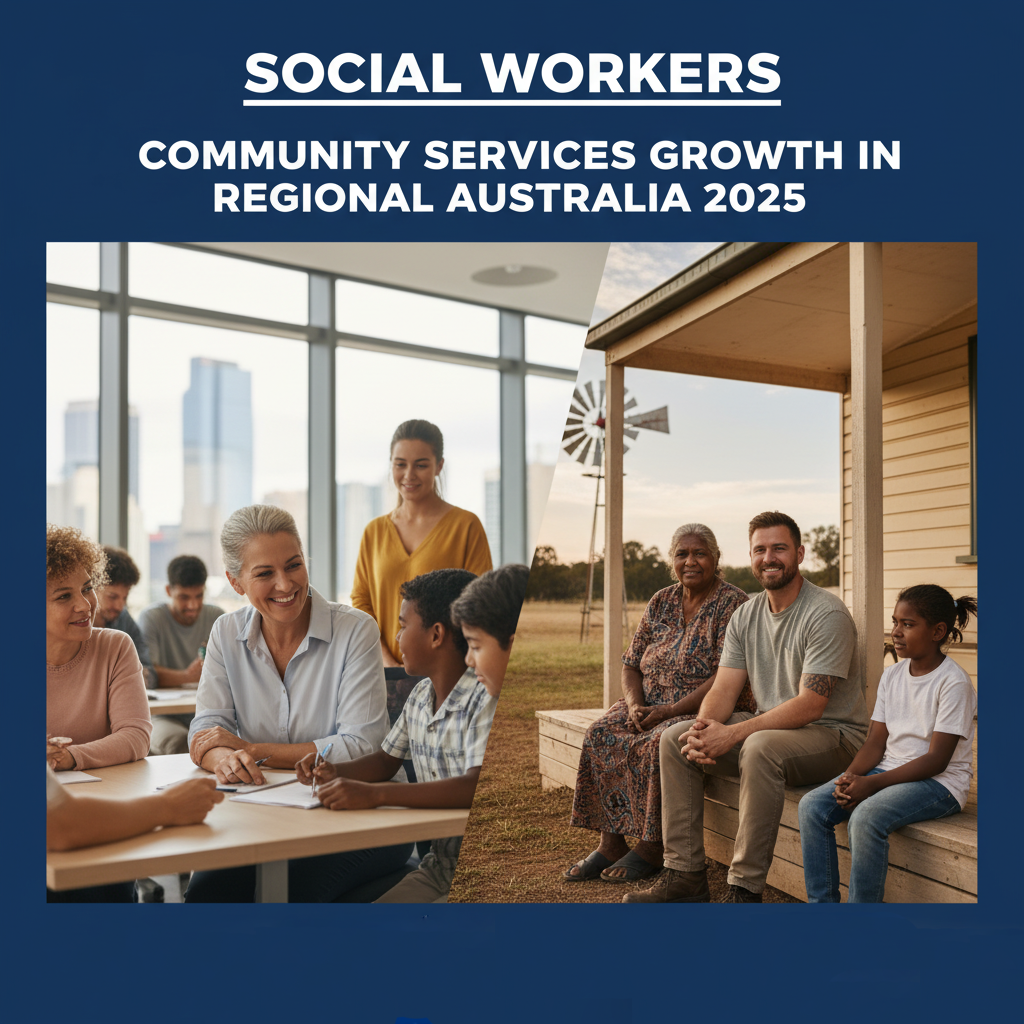
Explore the rising demand, migration pathways, and career opportunities for social workers in Australia’s growing regional community services sector in 2025.
Introduction
Regional Australia is experiencing a significant growth in community services, leading to increasing demand for qualified social workers. This article highlights the challenges immigrants face, available skilled migration pathways, and expanding career prospects in Australia’s regional social work sector in 2025.
The Problem Immigrants Face: Barriers to Entering Regional Social Work in Australia
Despite strong demand for social workers, immigrants face several challenges when trying to enter Australia’s community services workforce, especially in regional areas. A primary obstacle is qualification recognition, as overseas social work degrees and experience require assessment to meet Australian Association of Social Workers (AASW) standards.
Many immigrants must obtain Australian accreditation or complete bridging courses to qualify for registration. This process can be time-consuming and costly. Additionally, practical experience relevant to Australian community contexts is highly valued by employers but often difficult to demonstrate for newcomers.
Language proficiency and cultural understanding further affect effective client communication and integration into diverse regional communities. Immigrants often require support to adjust to Australian ethical, legal, and social frameworks governing social work practice.
Regional job markets, while offering excellent opportunities, present geographic isolation challenges. Access to professional networks, training, and mentoring may be limited, making early career development harder for migrants outside metropolitan hubs.
Furthermore, navigating visa options and securing sponsorship in regional areas involves procedural complexity, adding to immigrant hurdles. These cumulative factors require targeted programs and guidance to ensure immigrant social workers thrive in Australia’s regional community services growth.
The Solution: Skilled Migration Pathways and Professional Support
Australia has placed social workers on both the Core Skills Occupation List (CSOL) and Medium and Long-term Strategic Skills List (MLTSSL), reflecting the occupation’s critical demand. Several skilled migration pathways support qualified migrants looking to work in regional social work roles:
- Skilled Independent Visa (Subclass 189): For qualified applicants meeting points thresholds, offering permanent residency without employer or state sponsorship.
- Skilled Nominated Visa (Subclass 190): Requires state or territory nomination, often supporting regional social worker recruitment with additional incentives.
- Skilled Work Regional (Provisional) Visa (Subclass 491): For candidates committing to live and work in designated regional areas; pathways to permanent residency after three years.
- Employer Nominated Scheme (Subclass 186): Employer-sponsored permanent residency visa, applicable for social workers with approved sponsorship.
Obtaining a positive skills assessment from the Australian Association of Social Workers (AASW) is mandatory. The assessment evaluates education, supervised practice, and professional suitability per Australian standards.
Immigrants are encouraged to engage with support networks, cultural orientation programs, and continuing professional development to navigate regional social services effectively. Government funding boosts regional training initiatives, mentoring schemes, and community integration projects designed to expedite migrant workforce participation.
Regional Demand and Community Services Growth
Regional Australia has witnessed marked growth in community service demands driven by ageing populations, increased mental health needs, child protection cases, and family support services. Social workers are vital for providing frontline support in health, education, housing, and legal assistance sectors in these growing communities.
States like Queensland, South Australia, Western Australia, and Tasmania show particularly high demand for social workers in remote and regional towns where services are historically undersupplied.
Local councils, non-profits, health services, and indigenous community programs actively recruit social workers to fill gaps and improve access to vital services.
Government programs incentivize migration and retention in regional areas through relocation subsidies, additional professional support, and pathways to citizenship or residency focused on social care roles.
Career Opportunities and Highest Paying Roles
Career options range from direct client casework and crisis intervention to community development, policy advisory, and specialized roles in mental health or child welfare.
Higher paying positions typically align with supervisory, clinical social work, or community program management roles, with salaries averaging AUD 75,000 to 95,000 annually, dependent on experience, qualifications, and location.
Opportunities exist for social workers to engage in education, research, advocacy, and consultancy services as community needs evolve. Regional roles frequently provide a balanced work-life environment complemented by local community support and professional growth opportunities.
Action Steps to Get Started
Immigrants aiming to work as social workers in Australia’s regional community services should:
- Obtain Accredited Qualifications: Ensure your social work degree is recognized and accredited by the Australian Association of Social Workers (AASW).
- Complete Skills Assessment: Apply for a positive skills assessment through the AASW to meet visa eligibility.
- Apply for Relevant Visas: Consider Skilled Independent (189), State Nominated (190), Regional (491), or Employer Sponsored visas, depending on eligibility and preferences.
- Work Towards Registration: Register with state social work boards if required, to practice legally in Australia.
- Engage in Professional Development: Participate in bridging courses, cultural competency training, and Australian workplace induction programs.
- Target Regional Employment: Explore job vacancies and incentives in high-demand regional communities.
- Access Support Networks: Connect with regional social work associations and mentoring programs to ease integration.
Conclusion
Social workers are essential to the growth and wellbeing of regional Australian communities. Though immigrants face qualification and integration challenges, government support through skilled migration pathways and regional incentives opens promising career opportunities. By preparing thoroughly and focusing on regional roles, social workers can build impactful and rewarding careers in Australia’s expanding community services sector in 2025 and beyond.