




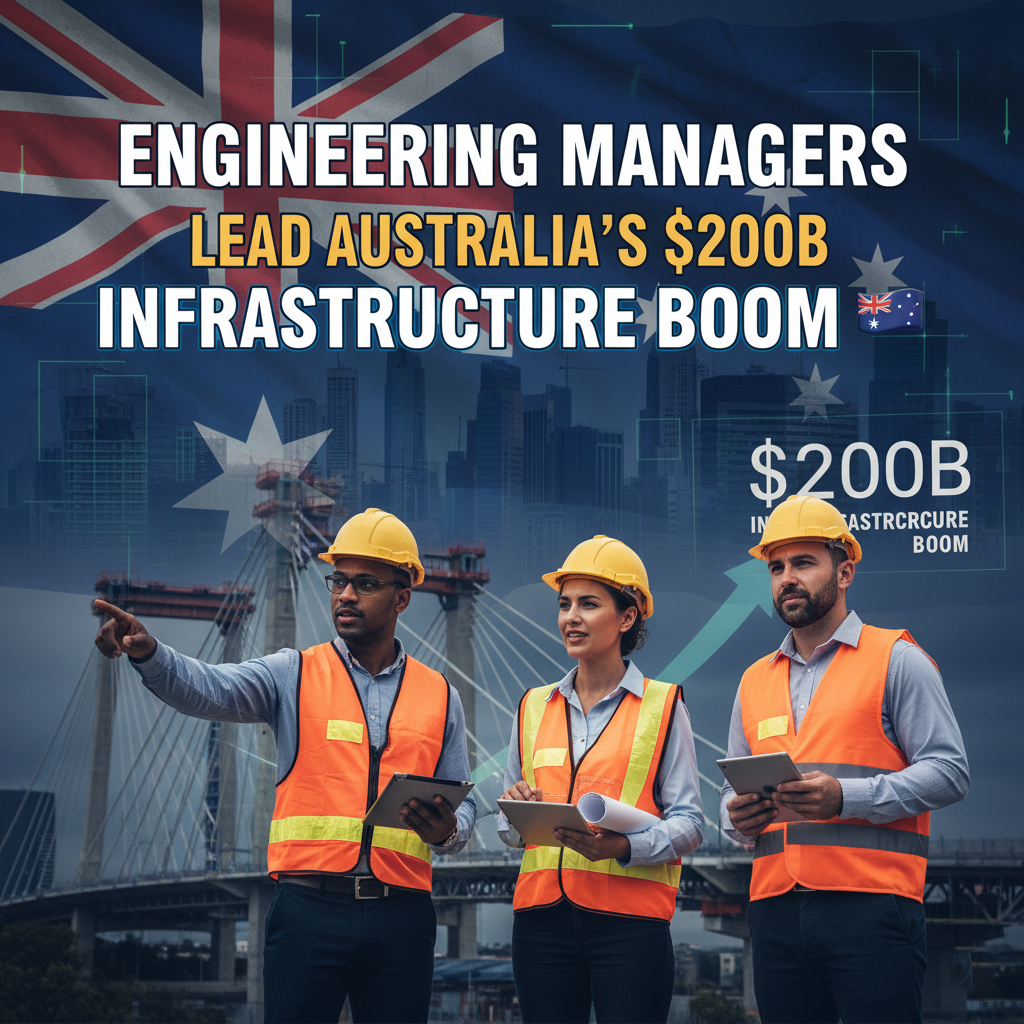
Skilled Engineering Manager Australia roles are driving major projects like Sydney Metro & Inland Rail. Discover the visa pathways, required Infrastructure Leadership skills, and high-value Engineering Jobs Australia across construction and renewable energy Australia sectors.
Engineering Managers: Leadership Roles in Australia’s Big Projects
Australia is in the midst of an unprecedented infrastructure boom, representing a pipeline of over $200 billion in planned and underway Major Projects Australia. This investment surge is creating a critical demand for skilled Engineering Manager Australia professionals. These leaders are not just overseeing technical teams; they are the strategic linchpins responsible for delivering massive, complex undertakings from conception to completion. For experienced managers worldwide, this environment offers challenging Senior Engineering Management roles, exceptional career progression, and a clear path to working in a vibrant, high-demand market.
The Scope and Scale of Australia’s Megaprojects
The nation’s commitment to modernising its essential services and capital cities translates into generational megaprojects that require world-class Infrastructure Leadership Australia. These projects are geographically diverse and span multiple sectors, confirming a sustained demand for engineering expertise.
The workload is staggering and highly visible:
Transport Infrastructure: This is dominated by major city-shaping ventures like the Sydney Metro expansion, the Melbourne Metro Tunnel, and Queensland’s Cross River Rail. These are complex tunnelling projects and civil construction requiring meticulous planning and safety management. The national network is also being transformed by the 1,700km Inland Rail project.
Energy and Resources: Beyond traditional Mining Projects in WA and QLD, Australia’s push for Renewable Energy Australia is creating a new frontier. Snowy 2.0, a pumped-hydro scheme, exemplifies the scale of the green energy initiatives needing expert direction.
Civil Infrastructure: Essential services such as water, waste, and road networks, like the West Gate Tunnel Project in Victoria, demand experienced Construction Manager Australia professionals to manage multi-billion dollar contracts and diverse contractor relationships.
Successfully delivering these projects requires Engineering Manager Australia professionals who can translate high-level designs into executable plans, manage intricate risk profiles, and lead diverse technical and construction teams.
Key Responsibilities and Required Expertise
The Engineering Manager role (ANZSCO 133211) transcends standard engineering duties. It is fundamentally a leadership and commercial position that demands a blend of technical depth and high-level managerial acumen. These managers are crucial to project governance and financial viability.
Essential Functions of an Engineering Manager
On Big Projects Australia, the responsibilities of a senior manager are broad and high-stakes:
Strategic Planning and Project Governance: Interpreting project designs and specifications to determine, implement, and monitor engineering strategies, policies, and plans. The manager often establishes the project’s schedule, budget, and overall quality/safety standards.
Contract and Risk Management: Managing multi-million dollar contracts, ensuring compliance, and providing expert advice on engineering methods and procedures to meet construction requirements. This involves proactive Risk Management Engineering to mitigate technical and safety issues.
Team and Stakeholder Leadership: Overseeing multi-disciplinary engineering teams, including the selection, hiring, and coordination of staff. They act as the primary technical interface with Project Director Australia roles, government agencies, and external contractors, demanding exceptional Stakeholder Management.
Quality and Compliance: Ensuring strict conformity with engineering standards of quality, cost, safety, timeliness, and performance, meeting all statutory and regulatory requirements.
The best-compensated Senior Engineering Management positions, particularly in resource and Mining Projects, require demonstrable experience in operating within remote environments and managing substantial financial portfolios.
Migration Pathways for Engineering Manager Australia
The demand for Engineering Jobs Australia means the role of Engineering Manager (ANZSCO 133211) features prominently on many skilled occupation lists, offering clear pathways for international talent.
The Skills Assessment: Engineers Australia vs. IML
The mandatory first step for skilled migration is a positive skills assessment. The assessing authority for this specific role can vary based on experience:
Engineers Australia (EA): This is the primary authority for engineers. Applicants typically submit a Competency Demonstration Report (CDR), detailing their technical background, three career episodes, and ongoing professional development (CPD). This path suits candidates with a strong technical, degree-based engineering background who have transitioned into management.
Institute of Managers and Leaders (IML): This option is available for applicants who can demonstrate a higher proportion of managerial and leadership experience over pure technical engineering. If recent experience is heavily focused on managerial duties as opposed to hands-on engineering, the IML assessment may be more suitable. Choosing the correct authority is crucial for a successful visa application.
Key Skilled Visa Options
Once a positive skills assessment is obtained, an Engineering Manager has access to several visa options, often determined by SkillSelect and state nomination:
Skilled Independent Visa (Subclass 189): A permanent visa requiring no sponsorship, suitable for applicants with very high Expression of Interest (EOI) points.
Skilled Nominated Visa (Subclass 190): A permanent visa requiring state or territory nomination. States like NSW (driven by Sydney Metro) and Victoria (driven by Melbourne Metro Tunnel) regularly seek Civil Infrastructure managers.
Skilled Work Regional (Provisional) Visa (Subclass 491): A temporary visa requiring nomination by a state/territory or sponsorship by a family member residing in a designated regional area. This is highly relevant for roles on Inland Rail or major regional energy and Mining Projects. It provides a pathway to permanent residency via the Subclass 191 visa.
Employer Nomination Scheme (Subclass 186) & Temporary Skill Shortage (Subclass 482): These employer-sponsored visas provide either a permanent or temporary pathway when an Australian employer is willing to sponsor the applicant directly.
Salary Expectations and Career Progression
The financial rewards for Senior Engineering Management roles in Australia are highly competitive, reflecting the complexity and responsibility of delivering Big Projects Australia.
Salary Benchmarks
Salaries for experienced Engineering Managers vary significantly based on location, sector, and project scale:
General Industry: A mid-level Engineering Manager in a capital city can expect an average base salary range between $140,000 and $180,000 AUD (excluding superannuation and bonuses).
High-Value Sectors: The Mining Projects and Oil & Gas sectors, especially for FIFO (Fly-In/Fly-Out) roles in remote Western Australia and Queensland, often offer the highest packages, with experienced managers and Project Director Australia roles commanding $200,000 to over $300,000 AUD in total remuneration.
Infrastructure: Roles on Megaprojects like Snowy 2.0 or major Transport Infrastructure can also push the upper limits of the salary scale, reflecting the multi-billion-dollar budgets being managed.
The Path to Project Director
The career trajectory from Engineering Manager Australia is typically towards Project Director Australia or General Manager of Operations. The experience gained on Australian megaprojects—particularly in managing multi-disciplinary engineering and Construction Management Australia teams, handling government stakeholders, and overseeing major technical risks (e.g., in Tunnelling Projects)—is highly valued globally and locally. A key career differentiator is mastering Project Cost Control and strategic Project Governance.
Navigating the Australian Professional Landscape
Success for an immigrant Engineering Manager requires more than just technical competence; it demands a deep understanding of Australian professional culture, safety standards, and commercial practices.
Focus on Australian Standards
Every Engineering Manager must quickly adapt to specific Australian legislation and standards. This includes:
WHS (Work Health and Safety) Legislation: Australia maintains stringent safety standards, particularly in Civil Infrastructure and Construction Manager Australia roles. Demonstrating high-level Safety Leadership and a commitment to zero-harm cultures is non-negotiable.
Contractual Frameworks: Familiarity with Australian contracting models (e.g., AS 4000, AS 2124, and state-specific forms) is essential for managing tenders, variations, and claims.
Environmental and Sustainability Requirements: Projects, especially in Renewable Energy Australia, have significant environmental and social governance (ESG) obligations that managers must oversee.
Building Networks and Credibility
Networking is key to securing high-calibre Engineering Jobs Australia. Becoming a Chartered Professional Engineer (CPEng) with Engineers Australia, while not mandatory for migration, significantly enhances professional credibility and marketability, showcasing a commitment to local standards and professional development.
Conclusion
The role of Engineering Manager Australia is at the forefront of the nation’s infrastructure narrative. With billions invested in Big Projects Australia, the demand for experienced Infrastructure Leadership is stable and urgent. This unique intersection of high-value work, competitive compensation, and clear skilled migration pathways makes Australia an undeniable destination for global Senior Engineering Management talent. Start your skills assessment now to lead the next generation of Australian megaprojects.