



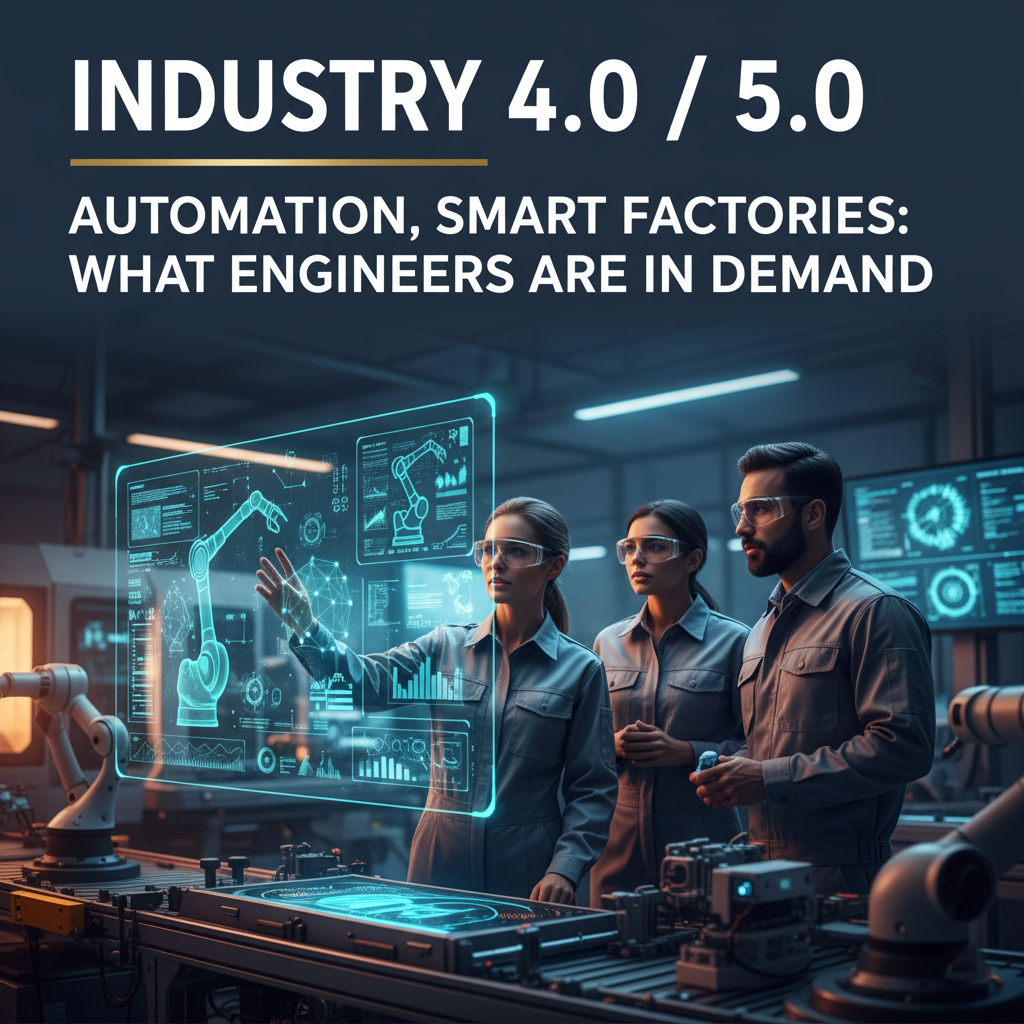
Discover in-demand engineers for Industry 4.0 & 5.0, from IoT to robotics specialists, and how smart factories drive automation and human-machine collaboration.
Introduction
The global smart factory market is projected to reach $155 billion by 2025, driven by Industry 4.0 engineers and emerging Industry 5.0 jobs (Statista). Automation, IoT, and AI are transforming manufacturing, creating a surge in demand for specialized engineers. Smart factories demand skilled professionals like robotics and IoT engineers to power automation engineering roles. This article explores which engineers are critical for smart manufacturing and how their skills shape the future of Industry 4.0 and 5.0.
Key Engineering Roles in Industry 4.0
Industry 4.0 engineers are at the heart of smart factories, leveraging automation and data-driven technologies. Here are the most in-demand roles:
- IoT Engineers: IoT engineers design and implement connected devices, enabling real-time data exchange in cloud IoT manufacturing. They use MQTT protocols and AWS IoT to optimize factory operations.
- Robotics Engineers: Robotics engineers develop automated systems for assembly lines, integrating cobots (collaborative robots) for tasks like material handling, crucial for smart manufacturing engineers.
- Automation Engineers: Automation engineers program PLCs and SCADA systems to control machinery, ensuring seamless automation engineering roles in production processes.
- AI Manufacturing Engineers: These engineers apply machine learning automation to predict equipment failures and optimize workflows, using tools like TensorFlow for AI smart factories.
- Industrial Engineers Industry 4.0: They streamline processes using lean principles and digital twin engineers to simulate factory layouts, boosting efficiency.
These roles drive smart factories demand by enabling data-driven, automated production systems.
Emerging Roles in Industry 5.0
Industry 5.0 jobs emphasize human-machine collaboration and sustainability, building on Industry 4.0’s foundation. Key roles include:
- Data Scientists Manufacturing: Data scientists in manufacturing analyze big data from IoT sensors to improve decision-making, using tools like Python and Hadoop for predictive maintenance engineers.
- Cyber-Physical Systems Engineers: These engineers integrate physical and digital systems, ensuring secure cyber-physical systems engineers workflows in interconnected factories.
- Predictive Maintenance Engineers: They use AI to predict equipment failures, reducing downtime in smart factory talent shortage scenarios with platforms like Siemens MindSphere.
- Supply Chain Automation Engineers: These professionals optimize logistics using supply chain automation engineers skills, integrating blockchain for transparency.
- Edge Computing Manufacturing Engineers: They deploy edge computing manufacturing engineers solutions to process data locally, enhancing speed and security with 5G integration for 5G smart factories roles.
Industry 5.0 human-machine collaboration prioritizes engineers who blend technical expertise with sustainable and human-centric solutions.
Skills and Technologies Driving Demand
The industry 4.0 job market demands engineers with specialized skills to support smart factories demand. Key technologies include:
- AI and Machine Learning: Machine learning automation powers predictive analytics and process optimization, requiring proficiency in tools like PyTorch or MATLAB.
- Digital Twins: Digital twin engineers create virtual factory models for real-time monitoring, using platforms like PTC ThingWorx for simulations.
- SCADA and PLC Systems: SCADA PLC specialists program control systems for automation, essential for automation engineering roles.
- Cloud and IoT: Cloud IoT manufacturing relies on platforms like Microsoft Azure for scalable data management, critical for IoT engineers.
- 5G and Edge Computing: 5G smart factories roles leverage high-speed connectivity, while edge computing manufacturing engineers ensure low-latency data processing.
These skills address the smart factory talent shortage by equipping engineers to handle complex, interconnected systems in AI smart factories.
Challenges and Opportunities for Engineers
The shift to Industry 4.0 and 5.0 presents both challenges and opportunities for engineers:
- Challenge: Skill Gaps: Many engineers lack advanced AI or IoT skills. Solution: Upskilling for Industry 4.0 through certifications like AWS IoT or Siemens PLC training closes this gap.
- Challenge: Rapid Tech Evolution: Keeping pace with accounting technology trends is tough. Solution: Continuous learning via platforms like Coursera ensures relevance.
- Opportunity: High Demand: The industry 4.0 job market faces a talent shortage, with 2.1 million unfilled manufacturing jobs projected by 2030 (Deloitte).
- Opportunity: Sustainability Focus: Sustainable automation jobs in Industry 5.0 prioritize eco-friendly designs, attracting engineers with green tech expertise.
- Challenge: Ethical AI Use: Ethical AI manufacturing jobs require transparency. Solution: Engineers adopt frameworks like IEEE’s AI ethics guidelines.
These dynamics highlight the need for adaptable, skilled engineers in smart manufacturing.
Immigration Opportunities for Engineers
For engineers eyeing global opportunities, Industry 4.0 engineers and Industry 5.0 jobs are in demand in countries like Germany, the US, and Singapore. Immigration pathways include:
- Germany’s Skilled Immigration Act: Targets automation engineers and IoT engineers with streamlined work visas for tech roles.
- US H-1B Visa: Ideal for AI manufacturing engineers and data scientists manufacturing, with high demand in Silicon Valley’s smart factory hubs.
- Singapore’s Tech.Pass: Attracts digital twin engineers and SCADA PLC specialists for its Industry 4.0 initiatives.
- Canada’s Global Talent Stream: Fast-tracks visas for robotics engineers and supply chain automation engineers in advanced manufacturing.
- Australia’s Global Talent Visa: Prioritizes sustainable automation jobs for engineers in smart manufacturing sectors.
Engineers should check eligibility and upskill to align with industry 4.0 job market demands for smoother immigration.
Conclusion
The future of smart factories relies on Industry 4.0 engineers and Industry 5.0 jobs, with roles like IoT engineers, robotics engineers, and data scientists manufacturing in high demand. Technologies like AI smart factories and cloud IoT manufacturing drive this shift, while upskilling for Industry 4.0 ensures career success. Engineers can seize global opportunities by targeting immigration pathways in tech-forward countries. Explore certifications and job boards like LinkedIn to join the smart manufacturing revolution.