




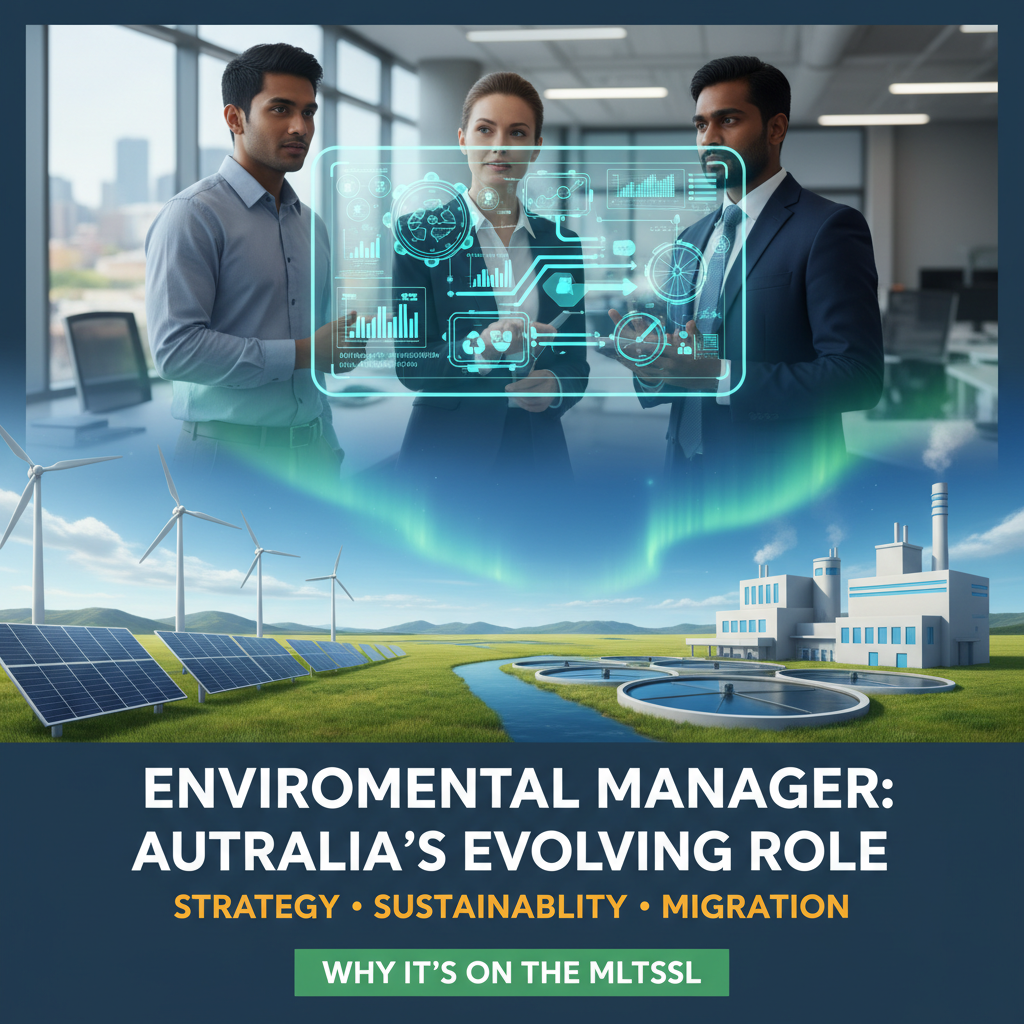
Discover how Climate Change Adaptation and new ESG reporting are transforming the Environmental Manager role in Australia. Learn why this crucial job is on the MLTSSL for skilled migration.
The landscape of Australian industry faces a profound and rapid transformation, driven by an urgent push for Decarbonisation / Net Zero Strategy and greater corporate accountability. In the eye of this storm is the Environmental Manager (ANZSCO 139912). Once focused primarily on site-level permitting and pollution control, this role has rapidly evolved into a strategic necessity. Australia’s commitment to new Regulatory Compliance Australia standards and the sheer scale of the challenges presented by climate change have created a monumental Skills Shortage List gap. This evolution explains why the role is prominently featured on the Medium and Long-term Strategic Skills List (MLTSSL Benefits), making it a premium target for skilled migrants globally.
From Compliance Cop to Corporate Strategist: The Evolving Role
The traditional Environmental Manager primarily ensured day-to-day Regulatory Compliance Australia, managed routine site inspections, and oversaw basic Waste Management Strategy and Pollution Control. Today, the scope has exploded, positioning the manager as a critical business leader influencing core operations, financial planning, and reputational risk.
The shift is most pronounced in the Infrastructure & Resources Sector, where large projects now face intense scrutiny. Environmental Managers are no longer just reacting to regulations; they are proactively driving Corporate Sustainability strategy. Their remit now includes implementing complex Climate Change Adaptation frameworks and translating ambitious net-zero targets into actionable, measurable business plans. This transition demands a unique blend of technical expertise and high-level strategic Stakeholder Engagement.
The modern manager must be proficient in managing an Integrated Management Systems that combines environmental, social, and governance elements, moving beyond siloed environmental checks. This ensures a holistic approach that aligns environmental goals directly with the company’s financial and social imperatives.
The New Mandate: ESG and Data-Driven Performance
The most significant change to the Environmental Manager’s responsibilities stems from the global rise of ESG (Environmental, Social, and Governance) and Australia’s subsequent adoption of mandatory climate-related financial disclosure. The government’s push for a “Green Economy” is not just about rhetoric; it’s about mandatory reporting and market expectation.
The Imperative of Reporting and Risk Management
Environmental Managers are now central to Environmental Performance Reporting. They are responsible for collecting, analysing, and managing vast amounts of environmental data, from Scope 1, 2, and increasingly, Scope 3 greenhouse gas emissions. This requires robust Environmental Data Management systems. The role shifts from simply tracking compliance to accurately reporting financial and operational risks associated with environmental factors.
Key responsibilities now include:
- Data Analysis and Reporting: Translating complex technical data into clear, financially relevant disclosures for investors and regulators.
- Environmental Risk Management: Identifying, quantifying, and mitigating physical (e.g., extreme weather) and transition (e.g., policy changes, market shifts) climate-related risks.
- Environmental Impact Assessment (EIA): Not just conducting EIAs for new projects, but integrating EIA findings into project design from the outset, focusing on achieving “net positive” outcomes.
- Environmental Auditing: Conducting detailed audits to provide limited or reasonable assurance over mandatory Environmental Performance Reporting.
This focus on data and financial risk means the contemporary Environmental Manager needs commercial acumen and exceptional analytical skills far beyond the traditional scientific background.
Why Environmental Manager is on the MLTSSL
The inclusion of the Environmental Manager (ANZSCO 139912) on Australia’s MLTSSL (Medium and Long-term Strategic Skills List) is a direct response to the national need for these new strategic skills. The MLTSSL is a government list identifying occupations considered in persistent, high demand across Australia’s economy, deemed vital for long-term economic growth and resilience.
Critical Shortage in a Growing Industry
Australia’s ambitious Net Zero Strategy, major Infrastructure & Resources Sector projects, and the mandatory nature of ESG disclosures have created a profound labour market imbalance. Australian businesses need a specific skill set—the ability to bridge environmental science, corporate strategy, and compliance—which is not currently met by the local workforce alone. This critical need positions the Environmental Manager role squarely on the national Skills Shortage List.
The MLTSSL Benefits for applicants are significant, primarily offering pathways to permanent residence through highly sought-after visas like the Skilled Work Visa Australia (e.g., Subclass 189, 190, 491). This preferential listing grants better access to independent and nominated visa streams, attracting the global talent necessary to manage Australia’s transition to a Green Economy.
The Immigration Pathway: VETASSESS and Skills
For aspiring Environmental Managers seeking to migrate, the skills assessment process is managed by VETASSESS. This body assesses both your formal qualifications and your employment history against the ANZSCO standard to determine your eligibility.
To be successful, applicants must demonstrate they possess a qualification assessed as comparable to an Australian Qualifications Framework (AQF) Environmental Management Degree or higher. Furthermore, the employment experience must show highly relevant tasks that align with the manager’s role.
The VETASSESS Requirements Focus
The modern role description, particularly the shift to strategic Data Analysis and Reporting, corporate-level Environmental Risk Management, and complex Policy Implementation, directly informs the VETASSESS assessment. Migrants must demonstrate experience not just in technical science, but in management-level responsibilities such as:
- Developing, controlling, and coordinating an Environmental Management System (EMS).
- Auditing and reporting environmental performance to senior management and external bodies.
- High-level Stakeholder Engagement with government, community groups, and internal executives.
Securing a positive skills assessment is the crucial first step toward applying for a permanent Skilled Work Visa Australia. With the average Environmental Manager Salary Australia reflecting the seniority and demand for this role, the career opportunity is professionally and financially compelling.
A Future-Proof Career Opportunity
The Environmental Manager role in Australia is no longer a niche compliance function; it is a strategic executive position essential for navigating climate change and meeting global Corporate Sustainable Development demands. This pivotal transformation is why the occupation holds a premium position on the MLTSSL.
For skilled professionals worldwide, this shift represents a golden opportunity. Australia is actively seeking managers with the expertise to deliver a Decarbonisation / Net Zero Strategy and manage complex ESG requirements. If you possess the blend of technical knowledge and strategic leadership now required, securing an Environmental Management Degree and validating your skills through VETASSESS is the key to a future-proof Green Jobs career in Australia.