




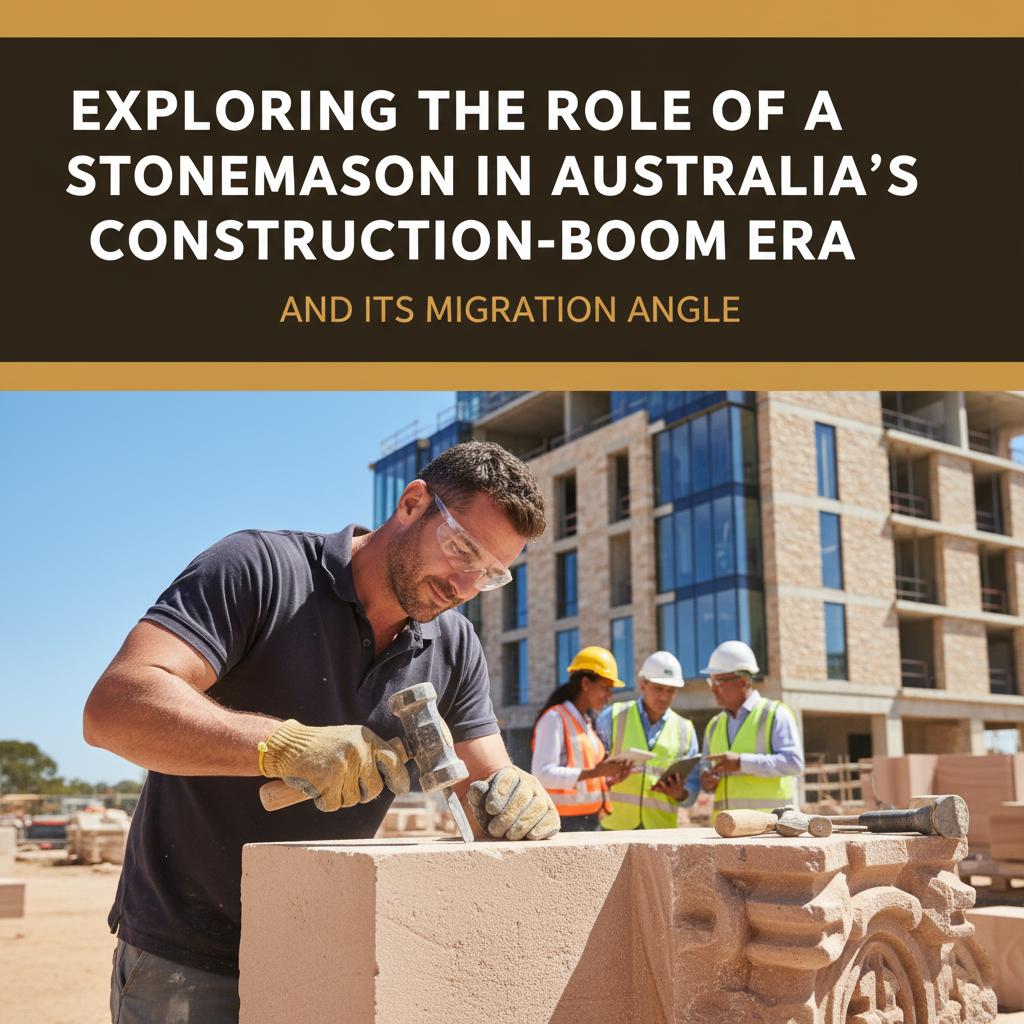
Uncover the crucial role of the Stonemason during Australia’s construction boom and the profound impact of Skilled Migrants—particularly Italian Migrants—who rebuilt the nation.
Exploring the Role of a Stonemason in Australia’s Construction-Boom Era and its Migration Angle
Australia’s post-World War II period saw the nation commit to a monumental project: rapid industrialization and urban expansion under the policy mandate to “Populate or Perish.” This era of furious Construction Boom Australia required a massive surge in Skilled Trades Australia. The demand for craftsmanship far outstripped local supply. Enter the Stonemason, a Building Craftsman whose ancient trade suddenly became critical for laying the solid foundations of modern Australia, from high-rise towers to vital public works. This article explores the indispensable Stonemason role in this transformative age and the compelling story of the Skilled Migrants who answered the call.
The Stonemason’s Indispensable Role in Post-War Construction
The Post-War Construction landscape was characterized by unprecedented scale, moving beyond simple residential housing into large-scale commercial and Infrastructure Development Australia. This necessitated workers skilled in heavy, durable materials, making the Stonemason and their specialized craft of Stonemasonry essential.
In a time before pre-cast concrete dominated, Architectural Stonework provided the lasting facades, load-bearing walls, and intricate detailing for countless landmark projects. The Stonemason was responsible for more than just cutting and setting stone; they shaped the very aesthetics of the new urban environment. Their tasks ranged from preparing raw material as a Quarryman to the precise execution of a Stone Setter in a city CBD. They worked across diverse projects: securing the foundations of major hospitals, crafting the elaborate entryways of new banks and government buildings, and laying kilometres of bluestone curbing and pavement—critical work for the emerging cityscapes of the 1950s Construction and 1960s. The need for these Trowel Trades professionals was not just significant; it was a matter of national priority, directly influencing the speed and quality of the entire Australian Construction effort.
Filling the Void: Australia’s Call for Skilled Migrants
The ambition of the Construction Boom Australia quickly collided with a stark reality: Australia lacked the domestic labour force to sustain it. With millions of new homes and commercial structures planned, the government recognized that mass Immigration Australia was the only solution. The skilled labour shortage was particularly acute in manual, hands-on trades like Stonemasonry.
To address this, the government initiated programs like the Assisted Passage Scheme, actively recruiting tradespeople from Europe. This policy was designed to meet two goals: rapidly increase the population and import essential skills. This led to a significant wave of European Immigration, bringing in highly experienced tradespeople whose skills had been honed over generations in their home countries. The Skilled Migrants who arrived were not just workers; they were carriers of specialized craft knowledge, ready to apply their expertise to Australia’s burgeoning cities. These new arrivals immediately stepped into critical jobs, transforming the workforce composition of the Australian Construction sector.
The European Influence: Italian and Maltese Stonemasons 🇮🇹🇲🇹
Among the arriving Skilled Migrants, certain groups became synonymous with Stonemasonry. Italian Migrants, in particular, brought with them a deep, continuous tradition of working with stone, passed down through family guilds and regional specialization. Their expertise in cutting, carving, and placing complex stone arrangements was unparalleled and instantly valued in Boom-time Building. Many Maltese and Greek tradespeople also contributed heavily, often working as a cohesive unit within the large construction teams.
These migrant Stonemason crews often worked on the most demanding projects, from detailed Architectural Stonework to the heavy structural masonry required for major public works. Their ability to deliver high-quality, precise work under pressure became a cornerstone of the construction industry’s success. The introduction of these skills also brought new techniques and materials to Australia. While contributing massively to the national output, these migrant groups often faced initial challenges with Trade Skills Recognition and navigating a new industrial relations environment dominated by Trade Unions Australia. Despite these hurdles, their collective contribution formed a crucial bridge between Australia’s post-war ambition and its modern reality, permanently embedding their Cultural Heritage Construction practices into the Australian building lexicon.
Challenges and Legacy: Working Conditions Migrants Faced 🛠️
While the Skilled Migrant tradesmen were essential for the Construction Boom Australia, their experience was not without hardship. They often faced challenging Working Conditions Migrants were forced to accept, including long hours, physically demanding labour, and sometimes discriminatory wages compared to their Australian-born counterparts. Language barriers often complicated site safety communication and limited their ability to negotiate better terms or gain swift Trade Skills Recognition.
Despite this, the long-term legacy of the migrant Stonemason is overwhelmingly positive. They were instrumental in the shift toward modern, large-scale building. Without the thousands of Italian Migrants and others who brought their specialized Trowel Trades to Australia, the pace of High-rise Construction and Commercial Building would have been severely retarded. Their work survives in the lasting stone foundations and iconic facades of major Australian cities, a visible testament to their sacrifice and dedication. Today, the continued demand for skilled masonry skills in heritage restoration and specialized building ensures that the trade remains a key component of Skilled Trades Australia, continuing the legacy established by the post-war newcomers.
The Modern Relevance of the Stonemasonry Pathway 🇦🇺
The story of the migrant Stonemason during the post-war Construction Boom Australia offers more than a historical footnote; it serves as a powerful model for modern Immigration Australia policy. Today, the need for skilled trades remains a critical component of Australia’s economic health, particularly as the nation engages in new phases of Infrastructure Development Australia. The specialized skills of the modern Stonemason are valued highly, not just for new builds but critically for the maintenance and restoration of the very buildings the Post-War Building generation constructed. This demonstrates a continuous, cyclical demand for this timeless trade, reinforcing its value as a viable and respected migration pathway. Understanding the historical context ensures that modern policies are better equipped to recognize and integrate foreign-acquired skills effectively.
Conclusion️
The Stonemason was a foundational hero of Australia’s construction boom era. The sheer ambition of Post-WWII Building would have been impossible without the crucial contribution of Skilled Migrants, particularly those from the European Immigration wave. These artisans, often Italian Migrants or Maltese Migrants, exchanged long-standing traditions for a chance to build a new life, literally laying the stones of modern Australia. Their legacy is visible in the structural integrity and Cultural Heritage Construction of every major city. If you possess Trowel Trades expertise, this history underscores the powerful, ongoing demand for your skills in Australia. Explore your migration options today and become part of the next chapter in Australian construction history.