




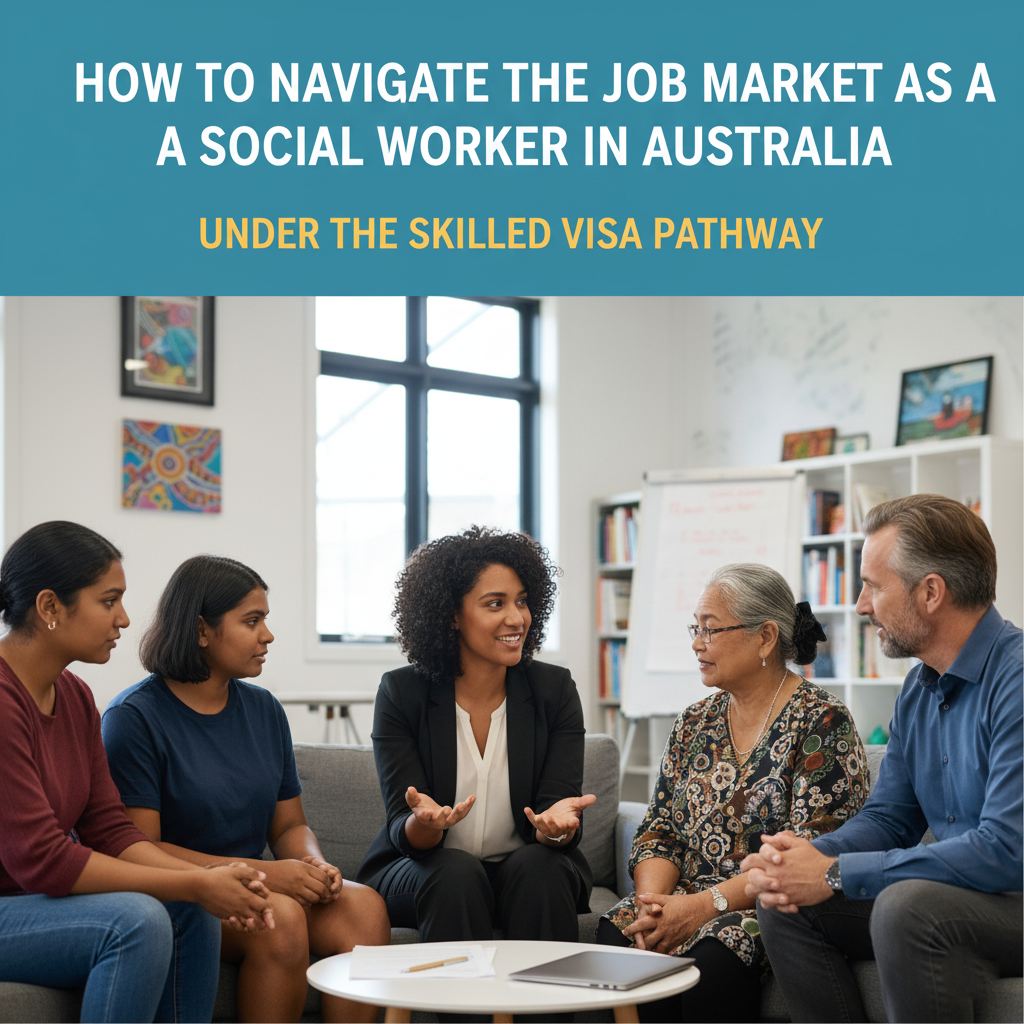
Unlock your career in Australia. This comprehensive guide details the essential steps for Social Workers (ANZSCO 272511) to secure a positive AASW Skills Assessment and find high-demand jobs.
The demand for qualified Social Worker ANZSCO 272511 professionals in Australia is exceptionally strong. Projected job growth over the next few years is in the range of 23%, driven by increasing needs in aged care, disability services, mental health, and child protection.1 This sustained growth positions Social Work as a leading pathway within Skilled Migration Australia. However, securing your visa and subsequent employment requires a strategic approach that addresses both immigration requirements and job market specifics.
This guide provides a professional, clear roadmap for internationally qualified Social Workers aiming to successfully navigate the entire process, from obtaining your skills assessment to landing a rewarding role.
Securing Your Skills Assessment with the AASW
The most critical first step for any skilled migrant is obtaining a positive skills assessment. For Social Workers, the designated assessing authority is the Australian Association of Social Workers (AASW).2 A positive assessment is mandatory for applying for independent, nominated, and regional skilled visas.3
Meeting the AASW Criteria
The AASW assessment compares your overseas qualification and professional experience against the learning outcomes of an AASW-accredited Australian qualification.4 Key criteria you must meet include:
- Qualification Comparability: Your professional Social Work qualification must be comparable to an Australian Bachelor or Master of Social Work (Qualifying).5
- Field Education: You must demonstrate a minimum of 980 hours of supervised field education in at least two placements with two different practice foci.6 One placement must be in direct practice.
- High-Level English: You must meet the English language requirement, which typically requires an IELTS Academic score of 7.0 in each band (Listening, Reading, Writing, and Speaking), or an accepted equivalent.7 Limited exemptions apply if you completed qualifying study in specific English-speaking countries.
The process of compiling documentation for the AASW assessment is rigorous. It often involves providing detailed course outlines, evidence of field placements, and, for some international qualifications, a statement linking post-qualifying work experience to the AASW learning outcomes. Treat this application with the same level of detail and professionalism as your visa application itself.
The Link to Visa Subclasses
A positive AASW assessment opens the door to several PR Pathway Australia visas:
- Skilled Independent Visa (Subclass 189): A permanent visa for applicants who meet the points test and do not require state/territory or employer sponsorship.8
- Skilled Nominated Visa (Subclass 190): A permanent visa requiring nomination from an Australian state or territory government.9 This is a common and highly viable path for Social Workers, as many states actively seek these professionals.
- Skilled Work Regional (Provisional) Visa (Subclass 491): Requires state/territory nomination and mandates living and working in a designated regional area for five years, with a pathway to permanent residency (Subclass 191).10 This is increasingly popular given the high demand for Regional Social Worker jobs.
The minimum requirement is 65 points on the points test, but invitation thresholds for Skilled Nominated Visa 190 and Subclass 189 can be significantly higher, making state nomination (Subclass 190) or regional work (Subclass 491) a strategic advantage.
Mastering the Australian Social Work Job Market
A visa application and a job search are two separate processes that must run concurrently. Successfully finding a role requires understanding the unique dynamics of the Australian Social Work job landscape.
Where the Demand Is Highest
While every state has a demand for social workers, the most critical needs exist in specific sectors and geographic areas:
| Sector / Specialization | Demand Snapshot | Key Locations |
|---|---|---|
| Child Protection | Consistent, critical need across all states; roles often within government agencies. | State-run departments (e.g., NSW Health, Queensland Government) |
| Aged Care & Disability | High and growing due to NDIS and ageing population trends. | Community services and non-government organizations (NGOs) |
| Mental Health | Strong demand, often requiring a specialization (Accredited Mental Health Social Worker). | Public hospitals, community clinics, private practice |
| Regional Areas | Significant shortages; often offer higher pay (due to incentives) and a more straightforward path to state nomination (491 visas). | Remote and regional centres like Rockhampton (QLD), Katherine (NT), or various parts of NSW. |
Government and defence, as well as the healthcare and medical sectors, tend to offer the highest average Social Worker salary Australia and have standardised pay scales.12 Senior roles, such as policy advisors or senior managers, often command salaries upwards of AU13$109,000 to AU$116,000 per year, particularly in areas with extreme shortages.14
The Employer Sponsorship Avenue
While the Subclass 189, 190, and 491 visas are points-tested, the Employer Sponsored Visa (Subclass 482) offers an alternative.15 If you can secure a Visa Sponsorship Social Worker role, an employer may sponsor you under the Temporary Skill Shortage (Subclass 482) visa, which can also provide a pathway to permanent residency (Subclass 186) after a few years.
This pathway is especially relevant for specialist roles or where you have significant experience that directly addresses a specific organisational need.
Tailoring Your Application for the Australian Context
Your overseas experience is valuable, but your job applications must be adapted to resonate with Australian employers, who operate within a specific cultural and legal framework.
Aboriginal and Torres Strait Islander Cultural Competency
A crucial element of Australian Social Work practice is Aboriginal and Torres Strait Islander cultural competency. Every professional engaging with Australian communities is expected to demonstrate an understanding of:
- Australian History: The impacts of colonisation, intergenerational trauma, and Stolen Generations policies.
- Cultural Safety: The ability to provide culturally safe and appropriate services to Aboriginal and Torres Strait Islander clients and communities.
- Self-Determination: Supporting the principle of self-determination in your practice.
Ensure your CV and cover letters include specific examples of how you have acquired and applied cultural competence, either through professional development, training, or relevant experience. This is a non-negotiable requirement for many government and community services roles.
Navigating Sector Differences
The Australian Social Work sector is typically split into three employment types:
- Government (Public Sector): Includes departments like Health, Child Protection, and Justice. These roles offer consistent salaries, defined career progression, and often mandatory training. The language is often procedural and focused on statutory requirements.
- Non-Government Organisations (NGOs)/Community Services: Includes non-profits focused on specific areas (e.g., homelessness, domestic violence, disability support). These roles may offer more diverse work, but salaries can vary more widely. The language is focused on client-centred practice and community development.
- Private Practice: Often involves clinical or mental health roles.16 This sector generally requires higher specialisation and registration as an Accredited Mental Health Social Worker.
Tailor your job application to the specific sector. Highlight statutory experience for government roles and community engagement skills for NGO roles.
Key Action Steps for International Social Workers
- Validate Your Qualification Early: Start your International Qualification Recognition assessment with the AASW immediately. This dictates your visa eligibility and proves you meet Social Worker job requirements Australia.17
- Boost Your English Score: Aim for the highest possible IELTS or equivalent score (e.g., 7.0 in all bands) to meet AASW requirements and to maximise your points for the Subclass 189/190/491 visas.18
- Target Regional and High-Need Areas: Research Regional Social Worker jobs and state nomination opportunities, especially under the Subclass 491 visa.19 This can significantly reduce the required points and expedite your migration.
- Network Strategically: Join the AASW as an International Member (once qualified) and attend virtual professional development events to build your understanding of local practice models, ethics, and cultural requirements.
Obtain Local Clearances: Start compiling documents for mandatory checks required for practice, such as the Working with Children Check and National Police Check (once in Australia).