




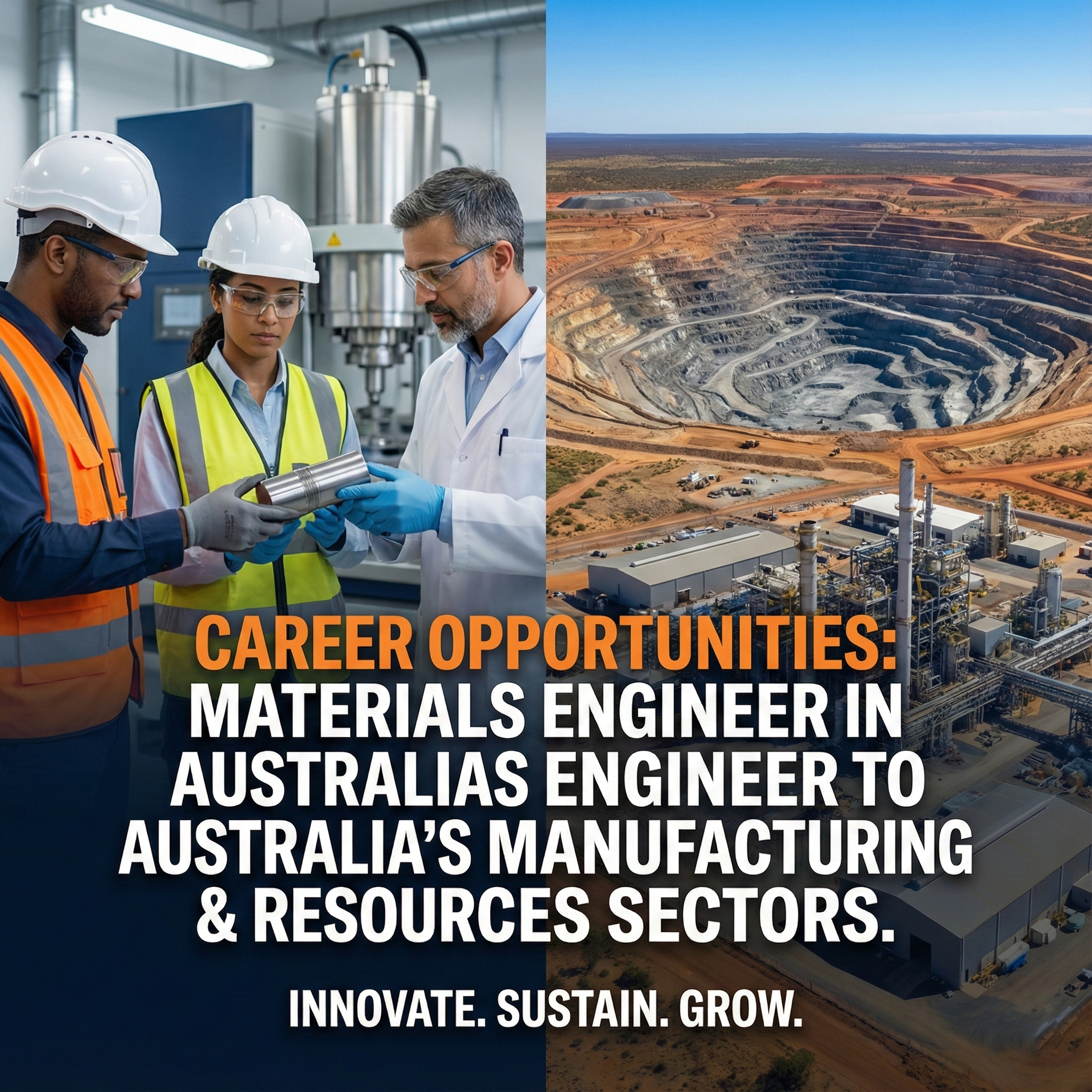
Discover high-paying materials engineer jobs in Australia’s mining, critical minerals, defence and advanced manufacturing sectors. Salaries, skills, CDR tips and fast-track migration pathways included.
Introduction
Australia’s critical minerals boom, AUKUS submarine project and “Future Made in Australia” manufacturing push have created an acute shortage of materials engineers. Materials Engineer (ANZSCO 233112) remains on the Core Skills Occupation List with priority state nomination in WA, QLD and SA. Experienced professionals now earn AUD 140,000–250,000+, especially in mining and defence. This guide reveals the exact sectors hiring, technical skills that guarantee interviews and the fastest legal route to permanent residency.
Resources Sector: Highest Salaries and Fastest Sponsorship
Western Australia and Queensland dominate materials engineering demand in mining.
Lithium, nickel and rare-earth projects need corrosion engineers, weld engineers and failure analysis specialists urgently. FIFO roles (8/6 or 2/1) routinely pay AUD 180,000–280,000 including site allowances and bonuses. Companies such as BHP, Rio Tinto, Fortescue, Lynas Rare Earths and Albemarle actively sponsor 482 and 186 visas for candidates with SEM-EDS, XRD and NACE corrosion experience.
Tailings and pressure-vessel roles require deep knowledge of AS/NZS 1554 welding and API 653 standards — reference these in your CDR and you move straight to interview.
Manufacturing & Defence: Growing Opportunities in 2025–2030
Eastern states and South Australia focus on advanced manufacturing.
The AUKUS submarine program alone will require hundreds of materials engineers specialising in high-strength steels, composites and additive manufacturing. Hanwha Armoured Vehicle Centre (VIC), Boeing Aerostructures (VIC/QLD) and CSIRO’s Lab22 offer permanent Melbourne and Brisbane-based roles from AUD 135,000–190,000.
Additive manufacturing engineers with Ansys Granta or Thermo-Calc skills are particularly scarce. Polymer and medical-device roles in Sydney and Melbourne start at AUD 120,000–160,000.
Skills That Get You Shortlisted Immediately
Australian employers filter resumes in seconds. Include these on page one:
- SEM-EDS and XRD for failure investigation
- Ansys Granta or CES Selector for materials selection
- Thermo-Calc or JMatPro for alloy design
- NACE CP or ICorr certification for corrosion roles
- Experience with AS/NZS 1554 and AS 4100
Mining candidates who can discuss probabilistic fatigue life or hydrogen embrittlement walk into offers. Defence candidates need ITAR awareness and composites experience.
Migration Pathway That Actually Works Right Now
Materials engineers enjoy some of the lowest invitation scores.
- Engineers Australia Skills Assessment (CDR route) Submit three career episodes referencing Australian or equivalent standards (AS/NZS 1554, API 653, etc.). Fast-track result in 15–20 days.
- Expression of Interest & State Nomination Current 189 cut-off sits at 90–95 points, but nomination drops it dramatically:
- Western Australia 190/491: regular offshore invitations at 70–75 points
- Queensland 190: strong for mining/metallurgy
- South Australia 190: defence and critical minerals priority
- Employer Sponsorship Mining giants and defence contractors routinely lodge 186 direct PR applications after six months on 482 visas.
Salary Comparison Across Sectors (2025 data)
- FIFO mining (WA/QLD): AUD 180,000–280,000+
- Defence & aerospace (VIC/NSW): AUD 145,000–210,000
- Advanced manufacturing (Melbourne/Sydney): AUD 130,000–180,000
- Graduate nationwide: AUD 95,000–125,000
Conclusion
Align your experience with AS/NZS 1554, corrosion standards or additive manufacturing tools and target Western Australia mining or AUKUS/defence projects. Materials engineers who prepare a strong CDR and apply for state nomination secure permanent residency and six-figure salaries within 12 months. The demand will only grow — start today.