




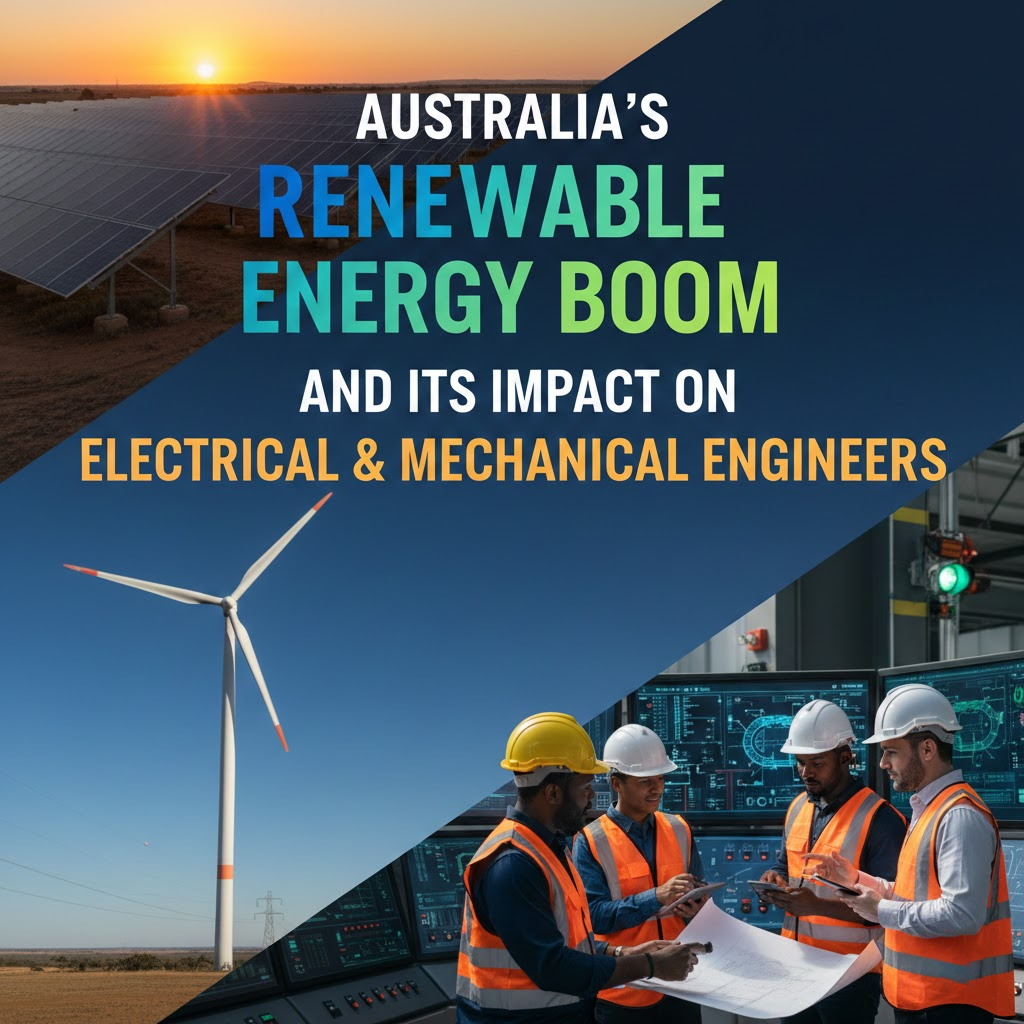
Australia’s renewable energy boom is creating thousands of jobs for electrical and mechanical engineers. Discover the solar power boom, wind projects, grid upgrades, skills in demand, and visa pathways for overseas engineers.
Introduction
Australia added a record 5.6 GW of new renewable capacity in 2024 alone, and the Australian Energy Market Operator (AEMO) forecasts that 82% of the National Electricity Market will come from renewables by 2030. Coal plants are closing fast, massive transmission projects are underway, and the country faces an acute skills shortage in power system engineering. For electrical and mechanical engineers worldwide, Australia’s renewable energy boom now represents one of the strongest migration and career opportunities on the planet.
Australia’s Renewable Energy Boom: Scale and Speed
The numbers are staggering. Rooftop solar PV already exceeds 20 GW, while large-scale solar farms and wind energy projects added another 7 GW in the pipeline for 2025–2026. Offshore wind projects in Victoria and New South Wales, plus Renewable Energy Zones (REZ) in Queensland and New South Wales, will require thousands of turbines and hundreds of kilometres of new HVDC transmission. Projects such as Humelink, Project EnergyConnect, and the rewiring of the entire NEM demand engineers who understand inverter-based resources, grid stability, and frequency control ancillary services (FCAS). Battery energy storage systems (BESS) and pumped hydro energy storage are also scaling rapidly to firm up intermittent generation.
How the Boom Changes Day-to-Day Work for Engineers
Electrical engineers now focus heavily on high-voltage engineering, substation design for renewables, SCADA systems, power electronics, and solar inverter technology. Many work on synchronous condensers and grid-forming inverters to maintain system strength as coal exits. Mechanical engineers find new roles in wind turbine design and maintenance, structural certification of towers, and balance-of-plant design for hybrid renewable projects. Green hydrogen and electrification of industry are opening entirely new specialties. Energy modelling, power system simulation (PSSE, PSCAD), and AEMO compliance have become daily tools rather than occasional tasks.
Skills Shortage and Priority Visa Processing
Australia faces a well-documented skills shortage in engineering for the energy transition. Electrical engineers (ANZSCO 233311) and mechanical engineers (ANZSCO 233512) appear on both the Core Skills Occupation List (CSOL) and the Priority Migration Skilled Occupation List (PMSOL legacy pathway). This triggers faster processing for the Skilled Independent (189), Skilled Nominated (190), and Skilled Work Regional (491) visas. Many renewable projects also qualify for employer-sponsored 482 or 494 visas with labour-market testing concessions in regional Renewable Energy Zones.
Pathways for Overseas Engineers to Join the Boom
Most international engineers start with a Competency Demonstration Report (CDR) assessment through Engineers Australia to prove equivalence to an Australian-qualified engineer. Positive skills assessments unlock points-tested visas or state nomination. New South Wales, Victoria, and Queensland actively nominate engineers who commit to renewable energy roles. Several large contractors and utilities (Transgrid, AusNet, Vestas, GE Renewable) now offer global talent programs that include visa sponsorship and relocation packages.
Conclusion
Australia’s renewable energy boom is not a distant target; it is happening now and accelerating toward Net Zero 2050. Electrical and mechanical engineers with renewable energy experience or a willingness to upskill are in critical demand. If you hold relevant qualifications, the combination of high salaries, permanent residency pathways, and meaningful climate-impact work makes Australia one of the best destinations worldwide.