




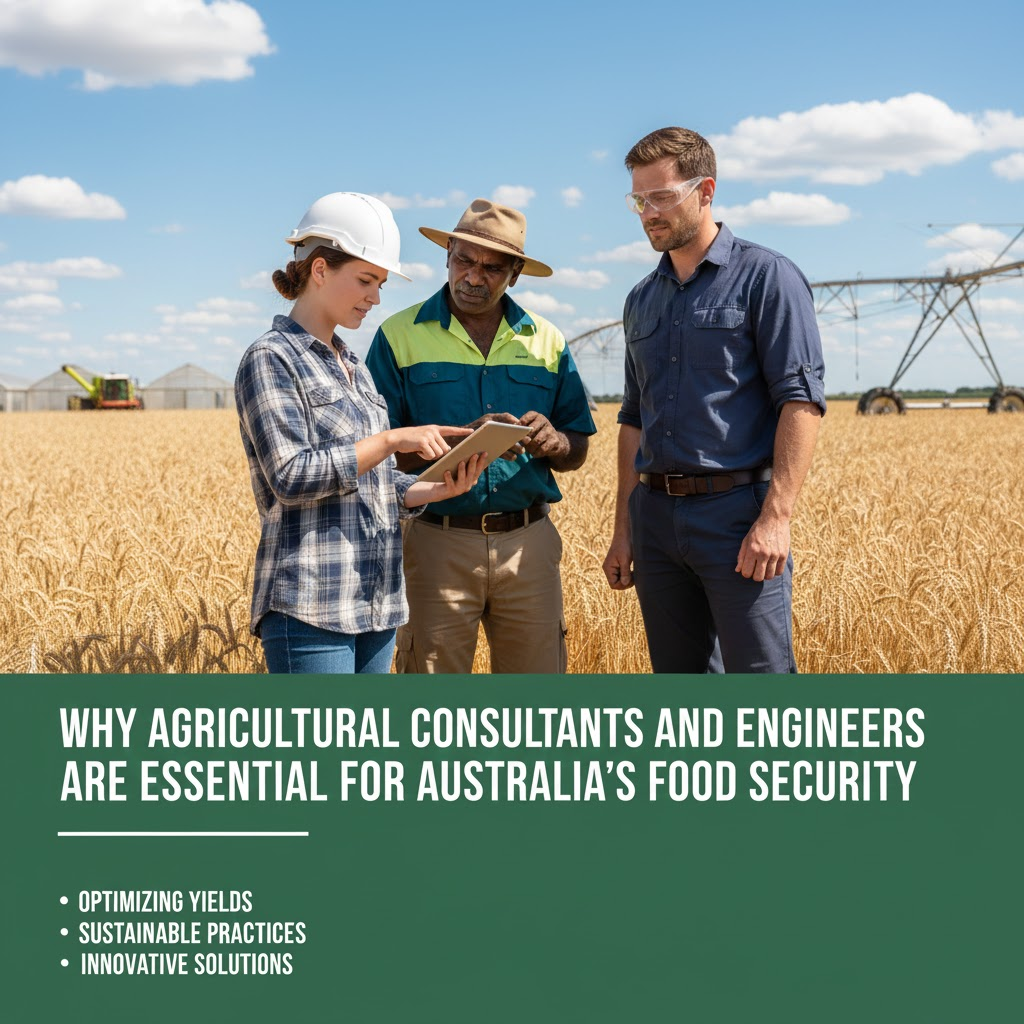
Agricultural consultants and engineers drive sustainable agriculture, precision farming, and drought resilience. Discover why Australia needs these experts to secure food production and supply chain resilience.
Introduction
Australia produces enough food for 75 million people annually—three times its population—yet climate change, water scarcity, and soil degradation threaten this advantage. Extreme weather events now cost the agricultural sector over $1 billion a year. To maintain food security and feed both domestic and export markets, the country relies on skilled agricultural consultants and engineers. These professionals deliver precision agriculture, water resource management, and climate-smart solutions that keep farms productive and resilient.
The Growing Challenges to Australian Food Security
Farms face intensifying pressure. Droughts last longer, bushfires strike more often, and flooding disrupts entire regions. The 2017–2020 Millennium Drought cut national farm output by 23%. At the same time, urban sprawl and mining compete for prime agricultural land, while biosecurity threats like fall armyworm and foot-and-mouth disease risk loom large.
Traditional farming methods no longer suffice. Farmers need data-driven farming, automated systems, and regenerative practices to protect soil health and boost crop yield optimization. Without expert guidance, many producers struggle to adopt these technologies quickly enough. This gap makes agricultural consultants and engineers indispensable for industry resilience and national food sovereignty.
How Agricultural Consultants Deliver Practical Solutions
Agricultural consultants bridge knowledge and action. They assess soil health management, recommend crop rotation plans, and introduce carbon farming techniques that improve both profitability and sustainability.
In the Murray-Darling Basin, consultants have helped irrigators switch to precision agriculture tools—soil moisture sensors, variable-rate irrigation, and satellite monitoring—cutting water use by up to 30% while maintaining or increasing yields. These farm advisory services also guide producers through government incentives for regenerative agriculture and net-zero agriculture projects.
During the 2022 eastern Australia floods, consultants rapidly redesigned drainage systems and adjusted planting schedules, saving millions in lost production. Their on-ground expertise turns complex challenges into workable strategies.
The Critical Role of Agricultural Engineers
Agricultural engineers design the infrastructure that makes modern farming possible. They plan irrigation engineering projects, build containment systems for livestock effluent, and develop farm automation solutions from robotic harvesters to drone-based spraying.
In Western Australia’s grain belt, engineers have rolled out controlled-traffic farming layouts that reduce soil compaction and increase wheat yields by 10–15%. In Queensland’s horticulture regions, they design climate-controlled greenhouses and water recycling systems that extend growing seasons and slash resource use.
These professionals also strengthen rural infrastructure—better roads, silos, and renewable energy microgrids—that keep supply chains functioning when disasters hit. Their work directly supports export-oriented agriculture, which accounts for over 70% of Australia’s farm production value.
Driving Agtech Innovation and Long-Term Resilience
Australia’s future depends on agricultural technology adoption. Consultants and engineers lead this transition. They test and integrate artificial intelligence, Internet-of-Things sensors, and blockchain traceability into everyday operations.
Projects like the “Digital Homestead” initiative rely on engineers to install broadband and sensor networks across remote properties. Consultants then train farmers to interpret the data for better decision-making. Together, they create drought resilience tools that predict water shortages months in advance and recommend pre-emptive livestock management systems.
This collaboration also strengthens biosecurity. Engineers design containment facilities; consultants develop rapid-response protocols. The combined effect protects both food production efficiency and public health.
Conclusion
Agricultural consultants and engineers do more than solve today’s problems—they build the systems Australia needs to feed itself and the world tomorrow. By championing sustainable agriculture, precision tools, and extreme weather adaptation, they safeguard food security against growing risks. Farmers, industry bodies, and government must continue investing in these experts to ensure a resilient, productive agricultural future.