




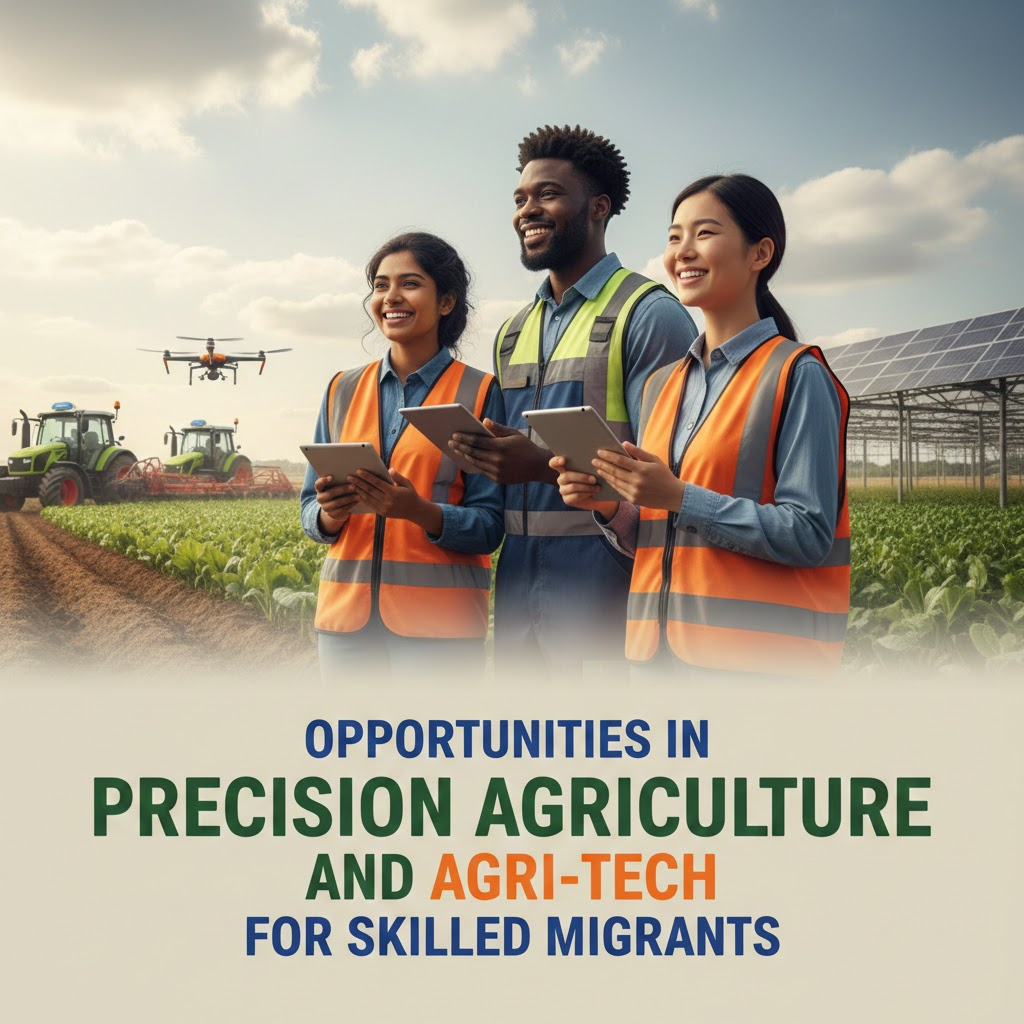
Discover high-demand AgTech careers in Canada, Australia, USA, UK & Europe. Explore agricultural visa programs, precision farming roles, salaries, and pathways for skilled migrants in agri-tech.
Introduction
The global agri-tech market will reach $46 billion by 2030, yet many countries face severe shortages of skilled workers who understand drone technology, agricultural sensors, AI in agriculture, and farm management software. Governments now actively recruit international talent through dedicated agricultural visa programs and rural skilled worker visas. For engineers, data scientists, agronomists, and robotics specialists, precision agriculture and agri-tech offer some of the fastest and most welcoming immigration pathways available in 2025–2026.
Why Precision Agriculture and Agri-Tech Need Skilled Migrants Now
Farmers lose billions yearly to inefficient resource use. Precision irrigation, variable rate technology (VRT), satellite imagery, and NDVI analysis can cut water and fertilizer costs by 20–40 %. Only a tiny fraction of farms worldwide currently use these tools at scale.
Countries with large agricultural sectors — Canada, Australia, the United States, New Zealand, and several EU nations — cannot find enough local talent trained in IoT in farming, agricultural robotics, autonomous tractors, GIS, or machine learning for yield prediction. Governments responded by creating or expanding fast-track visas that target exactly these skills.
Top Countries Offering Agricultural Visa Programs and AgTech Jobs in 2025
Canada
Provincial Nominee Programs (PNPs) in British Columbia, Saskatchewan, Manitoba, and Ontario include dedicated agri-tech streams. Roles such as agricultural data analyst, precision farming specialist, and farm software developer qualify under NOC codes that receive invitations at CRS scores as low as 350–400. Express Entry category-based draws in 2024–2025 added “Agriculture and Agri-Food” as a new targeted category.
Australia
The Subclass 491 Skilled Work Regional visa and the Pacific Australia Labour Mobility (PALM) scheme evolved to include long-term options. New “Agri-Food Technology” priority occupation lists added drone pilots, robotics engineers, and soil mapping specialists. States such as Queensland and South Australia offer state nomination bonuses of 15–25 points.
United States
The H-2A visa remains seasonal, but EB-3 “Skilled Worker” petitions for agricultural engineering jobs, controlled environment agriculture (CEA) technicians, and vertical farming technology experts are seeing record approvals. Companies sponsor green cards directly for roles in robotic harvesting and climate-smart agriculture.
New Zealand
The Accredited Employer Work Visa (AEWV) fast-tracks agronomists, precision livestock farming specialists, and greenhouse automation engineers. Median salary for these roles exceeds NZ$95,000, well above the median wage threshold.
United Kingdom & Europe
The UK Seasonal Worker visa extended to 2029 and now includes pilot routes to permanent settlement for poultry automation and dairy tech specialists. The Netherlands, Denmark, and Germany added “Green List” occupations for regenerative agriculture tech and carbon farming technology experts with immediate residence permits.
In-Demand Roles and Expected Salaries (2025)
– Agricultural Robotics Engineer – $90k–$140k USD equivalent
– Precision Agriculture Data Scientist / Machine Learning Specialist – $85k–$130k
– Drone Technology & Remote Sensing Analyst – $70k–$110k
– Farm Management Software Developer – $80k–$120k
– GIS & Soil Mapping Specialist – $75k–$105k
– Controlled Environment Agriculture (CEA) Manager – $80k–$125k
– Blockchain & Traceability Systems Developer – $90k–$135k
Many employers cover relocation, housing, and visa costs to attract international talent.
How to Position Yourself for These Opportunities
1. Highlight specific tools: Farm-ng, John Deere Operations Center, The Climate Corporation FieldView, Planet Labs, or DJI Agriculture drones.
2. Obtain certifications: Certified Crop Advisor (CCA), Precision Ag Specialist (CPAgS), or GIS Professional (GISP).
3. Build a portfolio with crop monitoring dashboards, yield prediction models, or autonomous tractor projects.
4. Use LinkedIn and AgriTech-specific platforms (AgCareers.com, AgFunder, PrecisionAg.com) to connect directly with sponsoring employers.
Success Stories
A Brazilian robotics engineer moved to Saskatchewan in 2024 on a PNP stream and now leads autonomous tractor deployment for a 50,000-acre farming operation. An Indian data scientist with experience in satellite imagery agriculture secured Australian permanent residency in under 10 months through the Global Talent Visa equivalent for agri-tech.
Conclusion
Precision agriculture and agri-tech represent one of the few sectors where skilled migrants enjoy genuine labor shortages, government-backed visa programs, high salaries, and clear paths to permanent residency. If you have skills in agricultural technology, now is the best time in a decade to explore international agricultural careers.