




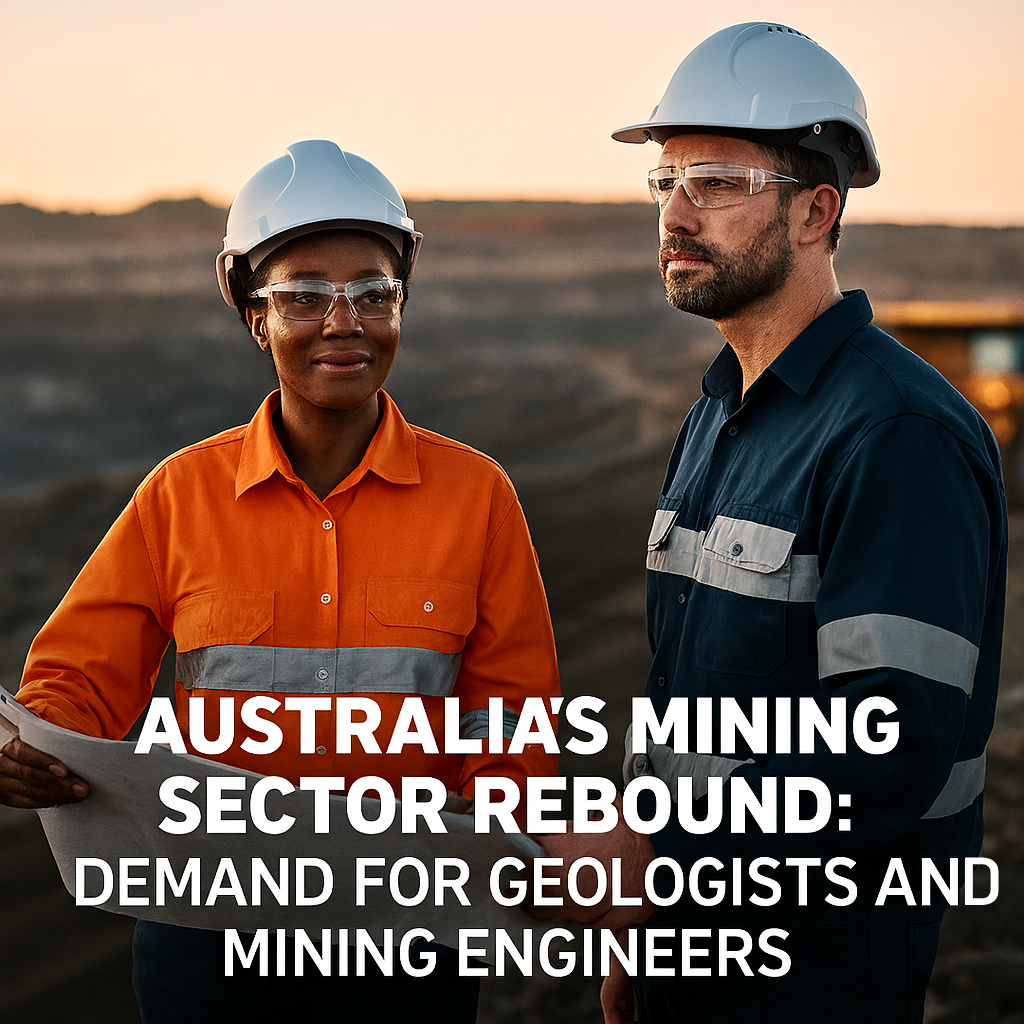
Australia’s mining sector rebound is creating thousands of geologist jobs and mining engineer jobs in 2025. Discover the skills shortage, high salaries, visa pathways, and how skilled migrants can secure roles in the critical minerals boom.
Introduction
Australia’s mining sector rebound has begun. Driven by global demand for critical minerals, lithium, copper, and rare earth elements, the resources industry now faces an acute skills shortage. Companies in Western Australia and Queensland struggle to fill geologist jobs and mining engineer roles fast enough. For experienced professionals worldwide, this translates into high-paying positions, fast-tracked visa options, and long-term career growth in one of the world’s strongest mining economies.
The Forces Driving Australia’s Mining Sector Rebound
Global decarbonisation and the battery metals boom have transformed Australia’s resources landscape. Lithium mining in Western Australia has tripled production since 2020, while new copper and rare earth projects gain momentum. Iron ore prices remain robust, and gold mining provides additional stability.
The Australian government lists geologists (ANZSCO 234411) and mining engineers (ANZSCO 233611) on the Core Skills Occupation List (CSOL). This priority status reflects real labour shortages reported by the Minerals Council of Australia and CME Western Australia. Employers in the Pilbara, Goldfields, and Bowen Basin regions urgently seek exploration geologists, mine planning engineers, hydrogeologists, and senior mining engineers.
Where the Jobs Are Concentrated
Western Australia remains the epicentre. The Pilbara mining boom continues with major iron ore expansions, while lithium and rare earth projects cluster around Perth and Kalgoorlie. Queensland mining jobs focus on copper, coal, and critical minerals in the North West Minerals Province and Bowen Basin.
Most roles operate on FIFO (fly-in fly-out) rosters—typically 2 weeks on, 1 week off—with camps providing meals, gyms, and Wi-Fi. Starting salaries for graduate geologists exceed AUD 100,000, while senior mining engineers commonly earn AUD 180,000–250,000 plus bonuses.
Visa Pathways for Mining Professionals in 2025
Skilled migration Australia 2025 offers multiple fast routes for geologists and mining engineers:
– Subclass 494 Skilled Employer Sponsored Regional Visa – the most popular pathway. Employers in regional areas (almost all mining sites) can sponsor overseas candidates within weeks. After three years, the visa converts to permanent residency (191 visa).
– Subclass 482 Temporary Skill Shortage (TSS) Visa – medium-term stream allows up to four years of work with a clear PR pathway.
– Subclass 186 Employer Nomination Scheme – direct permanent residency for candidates with Australian experience or exceptional skills.
Labour hire mining companies and METS sector firms also sponsor heavily, especially through the 494 visa mining jobs route.
How to Position Yourself for Success
Update your CV to highlight resource estimation, geological modelling, mine planning, or drill program management. Employers value software skills in Surpac, Leapfrog, Vulcan, or Datamine. Demonstrate experience with energy transition minerals (lithium, cobalt, nickel, copper) to stand out.
Register with specialist recruiters who focus on immigration mining professionals. Many large operators now run global recruitment campaigns and cover relocation costs.
Conclusion
Australia’s mining workforce demand shows no signs of slowing. Geologists and mining engineers who act now can secure high salaries, regional lifestyle benefits, and a direct path to permanent residency. Contact a registered migration agent and start the skills assessment process today—your next career move in the resources sector recovery is waiting.