




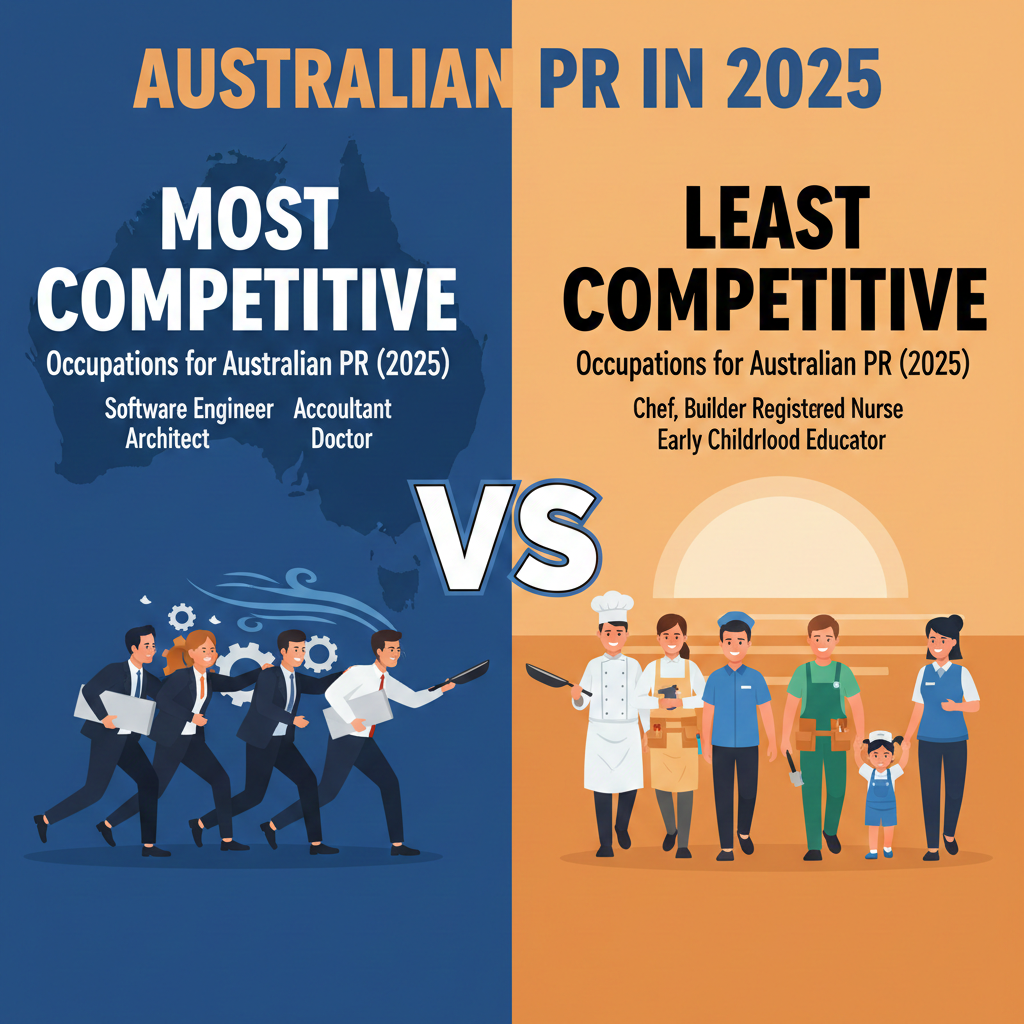
Highly Competitive Occupations
For many skilled migrants, the Skilled Independent Visa (Subclass 189) represents the ideal pathway, offering freedom from State Nomination. However, this visa stream is the most competitive, forcing certain Most Competitive Occupations to bid against each other with increasingly higher points.
The 90+ Point Club: Where Competition is Fierce
Certain professional groups consistently face high Visa Competitiveness in the Subclass 189 stream. While the minimum eligibility is 65 points, these roles often demand scores of 85 to 100+ to secure an invitation:
- ICT Professionals: Roles like Software Engineers, Developer Programmers, and Cybersecurity Specialists remain highly sought after by applicants worldwide. The volume of Expressions of Interest (EOI) for these roles is immense, driving up the required Minimum Points Score to 90 or more, especially for onshore candidates.
- Accountants and Auditors: These professions historically draw massive interest. While demand for these services exists, the number of qualified applicants far exceeds the annual Occupation Ceilings. They frequently become Pro Rata Occupations, where invitations are tightly rationed, pushing cut-off points well above 95.
- Civil Engineers and Management Consultants: While essential for Australia’s infrastructure, the applicant pool is also large. Many civil engineering roles require high scores, particularly from offshore applicants, often sitting in the 85–95-point range.
The key indicator for these categories is the combination of Low Invitation Volume relative to high applicant numbers, forcing candidates to amass points from every possible category, including superior English and partner skills.
The Solution: Lower-Competition & High-Demand Roles
A strategic approach to Skilled Migration means focusing on roles that are high-priority for the government—often referred to as High Demand Roles—or exploring less congested visa pathways. The least competitive occupations often demonstrate an urgent, persistent skill shortage that has yet to be flooded by international applicants.
Essential Services: Stable & Accessible Pathways
Occupations central to Australia’s healthcare and construction sectors offer significantly more stable and often lower-point pathways for Australian PR 2025:
- Healthcare Professionals: The demand for Registered Nurses (across various specializations) and Medical Technicians is critical and enduring. While competitive in terms of total numbers, invitation points for nurses often sit in the 75–85 point range for the Subclass 189 visa, and sometimes as low as 65 for regional or specialized streams. This suggests high priority and a consistent clearing of the EOI queue.
- Trades Occupations: Electricians, Plumbers, and Carpenters are currently experiencing urgent national shortages. These Trades Occupations regularly receive invitations for the Subclass 189 visa at the minimum 65-70 points, especially for skilled workers who already meet their trade qualification requirements. This points to a clear, high-priority need that translates into high Visa Competitiveness for the applicant, not against other applicants.
- Education Roles: Secondary School Teachers and Early Childhood Educators are prioritized, particularly in regional areas. Points typically sit in the 80–90 range, but the consistent nomination from state governments via the Skilled Nominated Visa (Subclass 190) pathway makes them a reliable option.
Strategic Advantage: Regional and State Nomination
The most effective strategy to overcome high competition in 2025 involves leveraging State and Territory Sponsored Visas and Regional Migration.
Leveraging Subclass 190 and 491 Visas
The Skilled Nominated Visa (Subclass 190) and the Subclass 491 Visa (Skilled Work Regional) provide a significant advantage that circumvents the fierce national competition of the 189 visas:
- The Point Boost: The 190 visa adds 5 points to your score, while the 491 visa (for a Designated Regional Area) adds a substantial 15 points. This is often the difference between a successful EOI and a stagnated application.
- Separate Invitation Queues: Each state or territory maintains its own State Occupation Lists and has its own invitation criteria. This allows candidates to target a state with a specific, urgent need for their occupation, bypassing the national backlog for Pro Rata Occupations like Accounting. For example, a state like Tasmania might invite a Counsellor or Social Worker at a lower point score than the 189 stream requires, simply because that state has a more critical, localized need.
Candidates must be prepared to commit to living and working in the nominating state or Regional Migration area for a specified period, but the immediate increase in PR prospects makes this the most important strategic tool.
Strategic Planning for PR Success
Securing Australian PR 2025 is less about raw skill and more about strategic visa selection. Highly skilled professionals in fields like ICT and Accounting must aim for a Minimum Points Score well above 90. Conversely, professionals in essential, in-demand areas like Trades, Nursing, and regional Education Roles can often succeed with a lower score by strategically targeting state or regional pathways. Researching Visa Application Trends and state-specific priorities is the best way to determine the true Visa Competitiveness of your occupation.