



The Impact of Automation and AI on Australia’s Skilled Job Market
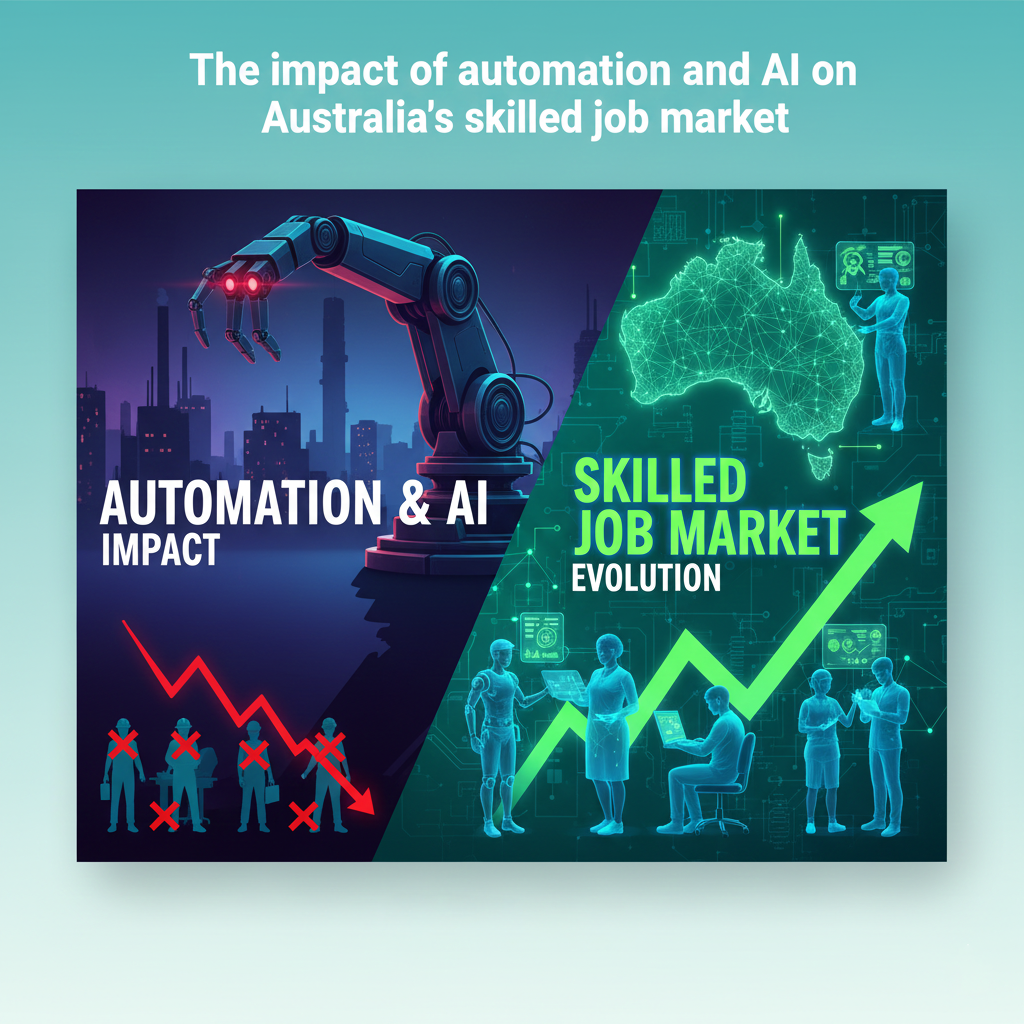
The Australian economy is at a critical juncture, facing a transformative wave of Digital Transformation Australia is undergoing. Generative Artificial Intelligence (AI) and increasing Automation are fundamentally reshaping the Skilled Job Market Transformation. Forget the fear of mass Job Displacement by AI; recent data suggests the real narrative is one of augmentation, not replacement. Industries most able to integrate AI are seeing up to three times higher growth in revenue per employee. This surge demonstrates that AI is making workers more valuable, not less. However, this shift is creating a massive demand for new, complex skills, fueling a need for targeted Skilled Migration and urgent Reskilling and Upskilling Australia wide. This article analyzes the Australian Labour Market Trends, identifying which jobs are being augmented, which are at risk, and where the most significant opportunities for skilled migrants lie.
The Dual Effect: Augmentation Drives Job Growth, Automation Refines Roles
The most comprehensive studies on the Future of Work Australia suggest that AI’s initial Automation Impact Australia is less about mass layoffs and more about augmentation. Roles where humans work alongside AI—known as “augmentable” jobs—have seen substantial growth across all industries. This is because AI excels at automating repetitive, high-volume tasks, freeing up human workers to focus on higher-value activities that require creative problem-solving, emotional intelligence, and strategic thinking.
For example, in Professional Services AI and Finance Automation, AI handles compliance checks and preliminary data analysis. This shift allows accountants, lawyers, and financial analysts to spend more time advising clients and strategizing complex deals, directly increasing Productivity Gains Automation enables. This productivity boost fuels expansion, leading to Job Creation AI drives in areas surrounding the technology itself.
However, the pressure is real for jobs primarily defined by routine tasks. Occupations most exposed to AI and Australian Jobs changes include Impact on Clerical Roles, such as data entry clerks, receptionists, and bookkeepers. While not immediately disappearing, these roles face profound refinement. Workers in these areas must adapt by acquiring new digital literacy and complementary “human” skills to remain competitive and transition into augmented roles.
Where the New Skill Demand Australia is Concentrated
The technological revolution has dramatically shifted the focus of New Skill Demand Australia. The market highly values workers who can develop, deploy, and manage AI systems, as well as those who can work effectively with them. This has created a boom in technology roles and a new premium on specific soft skills.
The immediate and growing needs are concentrated in the tech sector. The Demand for Data Scientists Australia, Cyber Security Jobs Growth, and AI/ML engineers continues to outpace domestic supply. The Tech Council of Australia forecasts that AI could create up to 200,000 AI-centric jobs by 2030, a 500% increase from current levels. This shortage is so acute that AI-skilled workers currently command a significant wage premium.
Beyond technical specialists, the greatest demand is now for soft skills that AI cannot replicate:
- Critical Thinking and Complex Problem-Solving: Roles that require interpreting AI outputs, diagnosing novel issues, and creating bespoke solutions.
- Creative Thinking: Essential for product design, content strategy, and business model innovation.
- Talent Management and Mentoring: Skills necessary to manage diverse, augmented teams and facilitate company-wide change.
- Adaptability and Resilience: The ability to continually learn and adjust to new technological tools.
This focus on both advanced digital skills and essential human capabilities defines the concept of Future-Proofing Careers in the Australian context.
Policy, Migration, and the Strategic Skills Gap Analysis
Australia’s government recognizes the dual challenge of maximizing the $100+ billion economic opportunity of AI while ensuring the stability of the Australian Labour Market Trends. Government Policy AI is being shaped by extensive Skills Gap Analysis conducted by bodies like Jobs and Skills Australia (JSA).
To meet the high demand for global talent, the Migration Strategy AI is adapting. The government is maintaining a strong focus on the Skill stream of the permanent migration program, with about 71% of places allocated to skilled workers. New visa settings, such as the proposed High-Tech Visa Stream and streamlined processing for priority roles, are directly targeting those with advanced digital and AI expertise. This strategic use of skilled migration aims to supplement National Training Reform efforts to build domestic capacity.
Crucially, migration policy now seeks to attract individuals with skills that foster innovation and fill the specific, high-end gaps identified by the Skills Gap Analysis. This includes workers in Australian Vocational Education and Training (VET) who can teach the technical skills needed for an automated future, alongside the high-end professionals driving the Digital Transformation Australia requires. The strategic alignment of immigration and domestic skills investment is key to realizing the full potential of AI-driven Productivity Gains Automation offers.
Strategic Moves for Skilled Migrants and Businesses
The shifting landscape of AI and Australian Jobs presents a clear path for skilled migrants. Workers with skills that augment or manage AI—rather than being displaced by it—will find themselves in high demand, with faster visa processing and better job prospects.
For skilled migrants, the strategy is clear:
- Obtain AI-Complementary Skills: Focus on specialisations in data governance, prompt engineering, machine learning ethics, and Cyber Security Jobs Growth.
- Highlight Soft Skills: Ensure resumes and interviews prominently feature skills like critical thinking, collaboration, and adaptability—the Role of Soft Skills in Automation Era.
- Target High-Growth Industries: Look beyond traditional IT to industries undergoing rapid transformation, such as Finance Automation or advanced Manufacturing Robotics.
For Australian businesses, the imperative is Reskilling and Upskilling Australia‘s existing workforce. Investing in micro-credentials and AI-literacy programs for current staff is vital, alongside leveraging the skilled migration pathway to attract necessary global expertise to fill the High-Tech Visa Stream roles immediately. Successfully integrating automation requires a human-centric approach that ensures workers are prepared for the change.
Conclusion
The impact of automation and AI on Australia’s skilled job market is a narrative of evolution, not elimination. While some roles, particularly those associated with Job Losses in Administration, face deep structural change, the overriding trend is one of Job Creation AI drives and a significant premium on skills that complement technology. This demands an agile migration system and a commitment to Future-Proofing Careers through continuous learning. By strategically aligning skilled migration with New Skill Demand Australia—especially in technology and essential human skills—Australia can secure its future as a productive and innovative global economy. Take action now to equip yourself with the skills Australia’s future economy needs.