




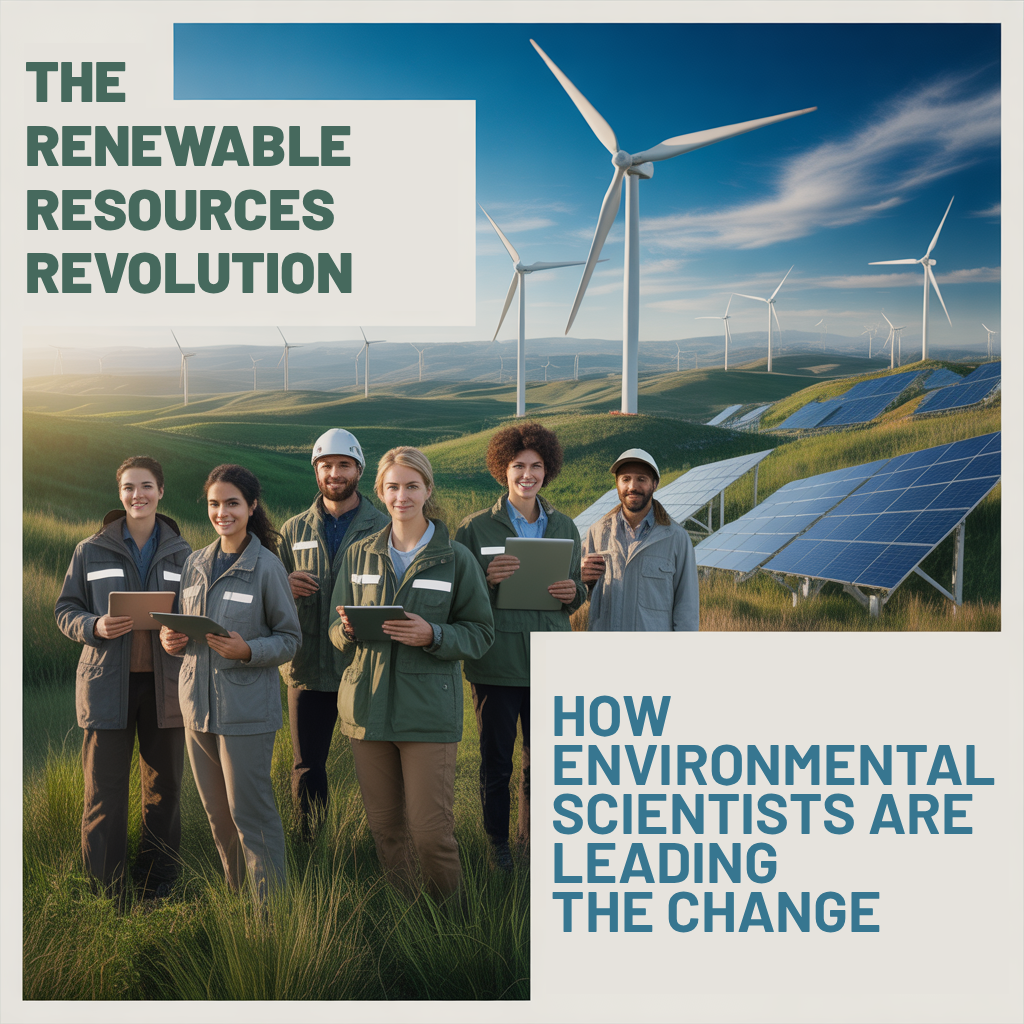
Environmental scientists drive the renewable resources revolution with breakthroughs in solar, wind, and green technology. Discover how their work accelerates the clean energy transition and fights climate change.
Introduction
Global renewable energy capacity grew 10% in 2024 alone, the fastest rate ever recorded. Behind this surge stand thousands of environmental scientists who turn data into action. They design better solar panels, optimize wind farms, and unlock new forms of bioenergy. The renewable resources revolution is not a distant dream — it is a science-led movement happening now. This article explores how these experts lead the shift to a sustainable, low-carbon future.
The Critical Role of Environmental Scientists in the Energy Transition
Environmental scientists bridge research and real-world impact. They monitor climate patterns, assess ecosystem health, and test renewable technologies under extreme conditions. Their work directly informs the global energy transition.
For example, atmospheric chemists have improved solar panel efficiency by studying how dust and pollution reduce output. Marine biologists map ocean currents to place floating wind farms in high-yield zones. Soil scientists develop biomass crops that capture carbon while producing fuel. Without their evidence-based findings, policymakers and engineers would lack the data needed for rapid decarbonization. These professionals also advocate for stronger climate action, ensuring science shapes laws and investment decisions.
Breakthrough Renewable Technologies Scientists Are Scaling Today
Innovation moves fastest when scientists collaborate across disciplines. Several renewable resources have reached tipping points thanks to their work.
– Solar power: Materials scientists created perovskite-silicon tandem cells that now exceed 33% efficiency in labs, pushing costs below coal in sun-rich regions.
– Wind energy: Atmospheric modelers use AI-driven weather forecasts to boost turbine output by 15–20% through predictive maintenance and blade adjustments.
– Green hydrogen: Electrochemistry researchers slashed the cost of electrolysers by switching to earth-abundant catalysts, making hydrogen viable for heavy industry.
– Next-generation geothermal: Seismologists and reservoir engineers perfected enhanced geothermal systems that work in areas without natural hot springs.
– Energy storage: Battery chemists replaced cobalt with sodium and iron, cutting costs and removing supply-chain risks tied to mining.
Each advance started in a lab run by environmental or related scientists determined to solve climate change with practical, scalable solutions.
From Research to Policy: How Scientists Drive Systemic Change
Data alone does not create change — influence does. Environmental scientists actively shape the rules that accelerate the renewable revolution.
They author IPCC reports that force governments to raise ambition. They testify before parliaments to defend carbon pricing and renewable subsidies. Many lead citizen-science networks that pressure corporations to adopt net-zero targets. Others found startups that commercialize university patents, turning grants into gigawatts of clean power. This combination of rigorous research and strategic advocacy gives science a decisive voice in the race to carbon neutrality.
Conclusion
The renewable resources revolution succeeds because environmental scientists refuse to separate discovery from deployment. Their breakthroughs in green technology, climate modeling, and ecological innovation prove that a sustainable future is within reach. The next decade will decide whether we limit warming to 1.5°C. Supporting these scientists — through funding, policy, and public awareness — remains the fastest way to win that race.