



An Urgent Call: Australia’s Accounting Skills Shortage
Australia’s financial sector is at a crossroads. While the nation’s economy remains robust, its critical financial backbone—the accounting and auditing profession—faces a drastic labour market shortage.1 The demand for accountants Australia has never been higher. Projections indicate a significant rise in overall employment for Accountant jobs Australia over the next few years, requiring tens of thousands of new professionals. This persistent accounting skills shortage Australia is driven by both retirement rates and an evolving regulatory landscape that demands more sophisticated financial expertise.
This strong Australian financial sector employment trend makes roles under the ANZSCO 2211 salary code a priority for employers across the country. Key sectors, including Professional, Scientific and Technical Services, and Financial and Insurance Services, are aggressively recruiting. For skilled international professionals, this environment presents a rare and compelling opportunity for skilled migration accountant Australia. The traditional roles are changing, requiring new skills, and the competition for qualified talent is intense, driving up Accountant salary trends Australia.
Beyond the Ledger: The Digital Transformation of Accounting
The work of a modern accountant or auditor extends far beyond traditional bookkeeping and compliance. Digital transformation accounting has redefined the core responsibilities, shifting the focus from historical reporting to strategic foresight.2 Automated systems now handle routine transaction processing, freeing up professionals to take on advisory accounting roles.3
To meet this evolving role of accountants Australia, new capabilities are mandatory:
- Data Analytics: Proficiency in data analytics for accountants is essential.4 Firms and companies now require professionals who can use data visualisation tools and statistical analysis to uncover business insights, manage risk, and forecast performance.
- AI and Automation: Understanding how to implement and manage AI and automation in auditing and general accounting processes is a critical new skill. Professionals who can leverage technology, rather than be replaced by it, are highly sought after by the Big Four accounting jobs Australia and corporate sectors alike.
- Technology Literacy: Familiarity with sophisticated ERP systems (SAP, Oracle) and accounting software like Xero and MYOB is a base requirement. The new frontier is the application of these tools to complex strategic problems.
The modern finance professional is now a strategic partner, interpreter of complex data, and business risk advisor, making these in-demand accounting skills Australia highly valuable.5
New Frontiers: ESG and Regulatory Compliance
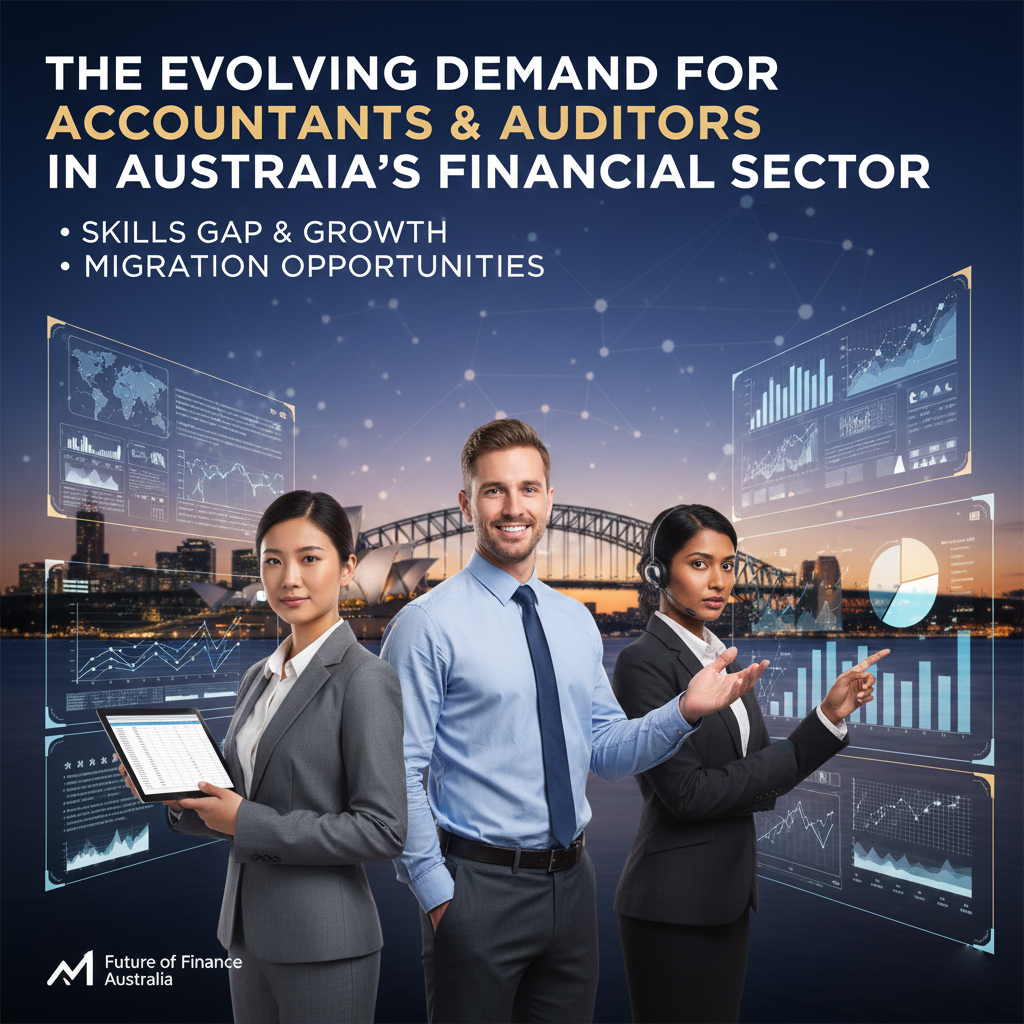
A significant driver of the evolving demand for accountants and auditors in Australia’s financial sector is the explosion in regulatory complexity, particularly around non-financial reporting. The global movement towards corporate social responsibility and sustainability is directly impacting finance teams.6
The Rise of ESG Reporting
Mandatory climate-related reporting is being phased in for large Australian companies, creating an entirely new discipline: sustainability reporting accountants.
- ESG Reporting Australia: This involves measuring, analyzing, and reporting on Environmental, Social, and Governance (ESG) metrics.7 Accountants must now understand frameworks like the ISSB standards and how to apply them.8
- Assurance Demand: The need for independent verification means External Auditor salary Australia and job opportunities are increasing rapidly in the assurance space. Companies require auditors to attest to the reliability and accuracy of their ESG data, which pushes the demand for specialist Audit Manager salary Australia roles.
- Forensic & Risk: Increased global scrutiny also fuels demand in specialised areas like forensic accounting and compliance.9 Auditors are increasingly required to manage complex risk advisory services, contributing to the high volume of Auditor job vacancies Australia.
The convergence of finance, technology, and sustainability means professionals who develop expertise in ESG reporting Australia will see a significant boost in their CPA Australia salary potential and career trajectory.
High-Demand Specialised Roles and Salary Trends
The Australian financial sector employment trends show particularly strong growth in specialized functions that require specific experience. Candidates targeting Accountant jobs Australia should focus on these high-value areas to maximise their chances of successful migration and strong Accountant salary trends Australia.
| Role Category | In-Demand Roles | Salary Snapshot (Average Base – Mid-Level) | Key Functions |
|---|---|---|---|
| Financial/Corporate | Financial Accountant / Senior Financial Accountant | AUD $103,000 – $130,000 | Statutory reporting, compliance, general ledger oversight. |
| Management/Strategy | Management Accountant / Financial Analyst | AUD $111,000 – $118,000 | Budgeting, forecasting, variance analysis, strategic decision support. |
| Leadership/Control | Financial Controller jobs Australia | AUD $127,500 – $145,000+ | Overseeing all financial operations, internal controls, and team leadership. |
| Audit/Assurance | External Auditor / Internal Auditor | AUD $97,000 – $115,000+ | Independent assurance, risk assessment, controls testing, and regulatory compliance. |
This market intelligence is vital for those planning their Chartered Accountant (CAANZ) career path or seeking migration options. For example, a mid-level Financial Accountant salary Australia in Accountant jobs Sydney or Auditor jobs Melbourne will typically be significantly higher than the national average due to the concentration of corporate headquarters and the higher cost of living in these Australian capital cities finance talent pool areas.
Migration Pathways for Accountants and Auditors
The sustained and urgent demand for accountants Australia places the profession firmly on the nation’s priority migration lists, such as the Core Skills Occupation List accountant.10 The primary ANZSCO code for Accountants is 221111, while Auditors fall under a related code.11
Skilled migrants have several primary visa pathways to pursue Accountant jobs Australia:12
- Skilled Independent Visa (Subclass 189): A permanent residency visa that does not require state or employer sponsorship. It is point-tested and highly competitive, reserved for the most qualified candidates.
- Skilled Nominated Visa (Subclass 190): A permanent residency visa requiring nomination from an Australian state or territory. This is a common and highly active pathway due to the intense regional need. State nomination often requires a commitment to live and work in the nominating state, such as filling Auditor jobs Melbourne or Finance jobs Brisbane.
- Skilled Work Regional (Provisional) Visa (Subclass 491): A provisional visa leading to permanent residency. It requires nomination by a state/territory or sponsorship by a family member in a regional area. This is a crucial pathway, as areas outside the major capitals also need to build their Perth accounting recruitment pipelines.
To begin the process, applicants must undergo a skills assessment through a recognised body (like CPA Australia, Chartered Accountants ANZ, or IPA) to verify their qualifications and experience match Australian standards.13 This is the essential first step toward a Skilled migration accountant Australia application.
Seizing the Opportunity in Australian Finance
The evolving demand for accountants and auditors in Australia’s financial sector is creating a powerful opportunity. Australia needs more than just number crunchers; it urgently requires strategic advisors who blend traditional financial acumen with mastery of technology and non-financial reporting.14 The sustained accounting skills shortage and positive Accountant job market forecast Australia ensure a strong outlook for skilled professionals. By focusing on data analytics for accountants and ESG reporting Australia, candidates can future-proof their careers and successfully secure their place in one of the world’s most stable economies.