



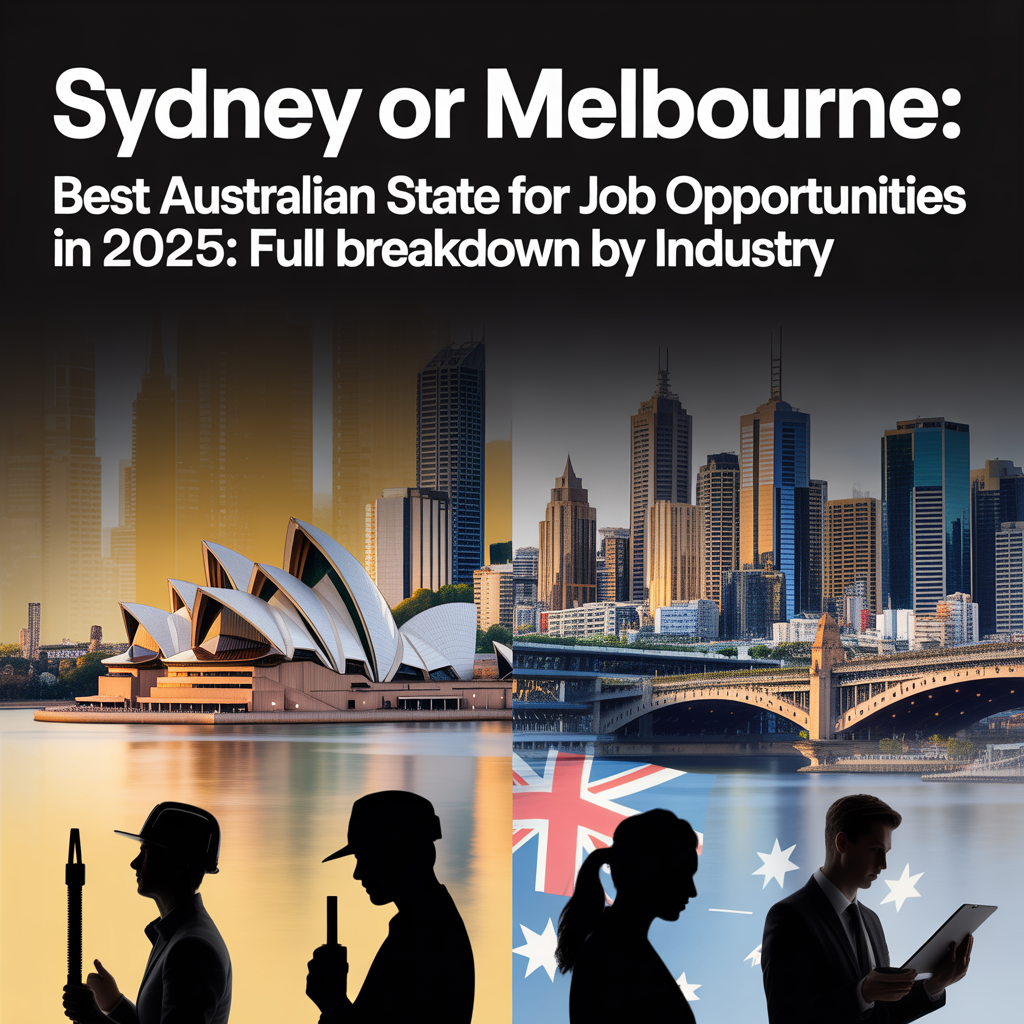
Discover the top Australian state for job opportunities in 2025, with a detailed breakdown by industry including tech, mining, healthcare, and more. Explore employment trends, shortages, and migration tips for skilled workers.
Introduction
Australia’s job market in 2025 shows resilience amid global uncertainties, with total employment reaching 14.7 million and unemployment steady at 4.3 percent. Yet, opportunities vary sharply by state and industry, driven by labour shortages in key sectors like healthcare and construction. For skilled migrants eyeing permanent residency, understanding these dynamics is crucial—state nominations now prioritize high-demand roles, offering faster pathways via visas like subclass 190 and 491. This guide breaks down the best Australian state for job opportunities in 2025, highlighting growth areas, unemployment rates by state, and strategies for success. Whether you seek tech roles in Sydney or mining jobs in Western Australia, align your skills with these trends to thrive.
Overview of the Australian Job Market in 2025
The Australian job market in 2025 remains tight, with 327,200 vacancies nationwide as of August, down slightly but still 110 percent above pre-pandemic levels. Deloitte forecasts employment growth easing to 1.5 percent in 2025-26, adding 218,800 jobs, fueled by public sector expansion in health and education. Non-market industries like healthcare and social assistance lead, projected to capture 16.7 percent of total employment by 2033, up from 15.2 percent.
Labour shortages persist in 29 percent of occupations, particularly technicians, trades, and health professionals. The government’s Skills in Demand visa targets these gaps, streamlining sponsorship for roles in engineering and aged care. For migrants, this means more state nomination spots—33,000 allocated for 2025-26—focusing on regional areas to balance urban-rural divides.
State differences shape the landscape. New South Wales and Victoria dominate high-skill jobs, comprising over 54 percent of advanced roles, while Western Australia excels in resources. Unemployment rates vary: Western Australia at 3.3 percent signals strength, versus South Australia’s 4.2 percent. Economic outlook points to 2.0 percent GDP growth in 2025-26, with renewables and AI driving innovation. Job seekers must match skills to these hotspots for optimal outcomes.
This overview sets the stage: no single state fits all, but data reveals clear leaders by industry. Next, we dive into top performers.
New South Wales: Tech and Finance Powerhouse
New South Wales (NSW) stands out as the best state to work in Australia for 2025, especially in tech and finance, with Sydney’s job market boasting over 200,000 postings—double pre-pandemic levels. Unemployment sits at 3.9 percent, the lowest nationally, reflecting robust demand. The finance sector in New South Wales thrives on Sydney’s status as a global hub, adding 145,000 professional services jobs by 2030, including accountants and financial analysts.
Tech jobs in New South Wales surge 66 percent, driven by AI and cybersecurity needs. Software developers and data scientists earn up to $150,000 annually, with firms like Atlassian expanding. For migrants, NSW’s state nomination program favors IT and engineering, granting 5,000 spots in 2025-26, often waiving points tests for priority occupations.
Beyond metros, regional NSW offers construction and renewables roles, with 20,000 green jobs projected via Renewable Energy Zones. Skilled migration Australia 2025 pathways shine here—subclass 491 visas target regional tech hubs like Newcastle. Challenges include high living costs, but incentives like graduate streams ease entry. Overall, NSW’s diverse economy makes it ideal for ambitious professionals.
Victoria: Healthcare and Education Leader
Victoria claims the top spot for healthcare jobs in Victoria and education roles, with Melbourne’s employment growing 2.5 percent amid a 9.2 percent five-year projection for the Australian Capital Territory—wait, no, Victoria leads with 283,000 new professional jobs by 2030. Unemployment at 4.0 percent masks hotspots: healthcare vacancies up 48 percent.
IT and technology in Victoria boom, with 70,000 added roles in software and data analytics. Melbourne’s ecosystem, home to universities like Monash, draws global talent. Nurses and aged care workers top shortages, earning $80,000-$120,000, as the sector absorbs 70,000 annual jobs. Education jobs Australia expand too—8,600 new aides and teachers by 2025, focusing on STEM.
State nominations prioritize these fields, allocating 4,000 spots for 2025-26, with regional bonuses for subclass 491. Regional vs capital city jobs in Australia favor Victoria’s outskirts for lower competition. Migrants benefit from post-study work rights, but housing pressures loom. Victoria suits those in caring professions seeking stability.
Queensland: Construction and Resources BoomQueensland excels in construction jobs Queensland and Brisbane job opportunities, with postings doubling
baselines and 25,000 new roles forecast. Unemployment at 4.1 percent belies growth: infrastructure projects add 60,000 jobs by 2030.
Brisbane’s market thrives on Olympics prep and mining ties, demanding electricians and plumbers—shortages hit 50 percent. Salaries reach $100,000 for trades. Renewables contribute, with solar projects creating 20,000 positions.
For skilled migration, Queensland nominates 3,500 for construction and health, favoring regional applicants via subclass 491. Perth job market comparisons show Queensland’s edge in work-life balance. Drawbacks: cyclone risks disrupt sectors. Ideal for hands-on workers.
Western Australia: Mining and Energy Frontier
Western Australia dominates mining jobs Western Australia, with Perth’s job market adding 32,000 roles by 2030 amid critical minerals demand. Unemployment at 3.3 percent—the nation’s lowest—signals strength. Engineers and drillers earn $150,000+, as exports hit records.
Renewables grow, with hydrogen projects boosting 60,000 jobs nationally, WA claiming 40 percent. State nominations cut to 3,500 but target trades. FIFO lifestyles suit migrants, but isolation challenges families. Top for resource pros.
South Australia: Renewables and Defence Growth
South Australia leads renewable energy jobs South Australia and defence industry jobs, with Adelaide employment growth at 2.2 percent. Postings double baselines; 20,000 green jobs projected. Unemployment at 4.2 percent, but shortages in electricians persist.
Defence expansions add 10,000 roles by 2030. Nominations favor these, with 2,500 spots. Affordable living attracts migrants. Strong for sustainable careers.
Other States: Niche Opportunities
Tasmania offers Tasmania job opportunities in tourism and renewables, with 5,000 new roles. Unemployment 4.0 percent; nominations open for trades.
Australian Capital Territory shines in public service and Canberra government jobs, projecting 9.2 percent growth. 13.7 percent vacancy rise. Ideal for policy experts.
Northern Territory lags in skilled growth but needs construction workers.
Skilled Migration and Job Strategies for 2025
Skilled migration Australia 2025 emphasizes state nomination Australia programs, with 33,000 spots addressing labour shortage Australia 2025 in health and trades. Target highest paying jobs Australia 2025 like surgeons ($200,000+) via Skills in Demand visa.
Tips: Assess points (65 minimum), secure sponsorship, and choose regional for bonuses. Industry growth Australia 2025 favors renewables (250,000 jobs). Network on LinkedIn; upskill in AI. Economic outlook Australia states predicts 12-16 percent employment rise by 2033.
Conclusion
New South Wales edges as the best Australian state for job opportunities in 2025, blending tech innovation with finance stability, though Victoria and Queensland closely follow for healthcare and construction. Align your expertise with these industry leaders—mining in WA, renewables in SA—to navigate shortages and secure nominations. Start by reviewing your occupation on the Core Skills List and consulting a migration agent. Act now: Australia’s market rewards proactive skilled workers with lasting careers.