


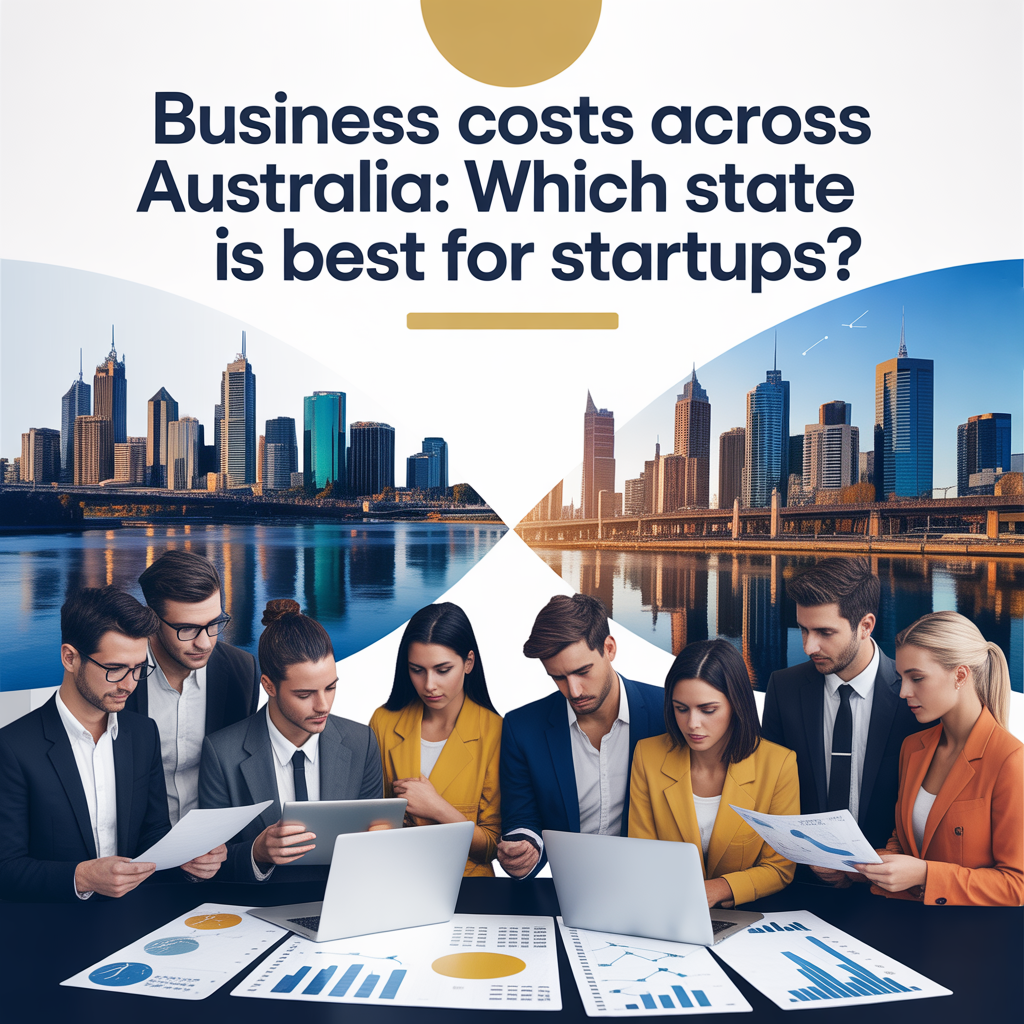
Compare business operating costs by state Australia: rent, wages, taxes, utilities, and incentives. Discover the cheapest state to start a business in 2025 and why South Australia wins for most founders.
Introduction
Australia welcomed over 3,500 new startups in 2025, raising $2.62 billion collectively. Yet small-business operating costs jumped 8% year-on-year, squeezing margins before the first sale. Location decides survival. Sydney demands premium rent while Adelaide and regional Queensland offer grants and lower overheads. This guide compares real business costs across Australia — from office space and wages to taxes and talent — to reveal the best state for startups right now.
Key Business Costs: Rent, Wages, and Utilities Across States
Commercial rent remains the biggest variable. Sydney’s prime CBD space averages $1,211 per square metre per year in 2025. Melbourne follows at $937, Brisbane at $866, Perth at $656, and Adelaide at $726 for comparable grade-A space. Founders who choose secondary locations or suburbs slash that figure by 20-40%. North Sydney, for example, drops to around $800 per square metre, and Brisbane’s Fortitude Valley sits well below $700.
Wages start from the same national minimum of $24.95 per hour (July 2025), but total employment costs differ. Every employer pays 12% superannuation plus workers’ compensation and payroll tax once thresholds are crossed. Payroll tax thresholds range from $1 million in Victoria and Western Australia to $1.5 million in South Australia. Rates themselves vary between 4.75% in Queensland and 6.1% in Tasmania for higher brackets. A five-person startup paying $80,000 average salary adds roughly $9,500–$10,000 annually in super and insurance, before payroll tax kicks in.
Utilities add another layer. Commercial electricity prices remain highest in South Australia and lowest in Tasmania and Queensland. A small office typically spends $350–$500 monthly on power and internet. NBN business plans start at $90–$100 per month in Brisbane and climb to $140–$160 in Sydney for equivalent 1000 Mbps symmetrical fibre. Remote or hybrid teams cut these costs by 25-35%, making distributed startups far cheaper to run almost anywhere.
Taxes, Incentives, and Hidden Savings by State
Federal corporate tax sits at 25% for companies under $50 million turnover or 30% above it, so state-level taxes create the real differences. Land tax exemptions start at $300,000 in Victoria but rise to $600,000 in Queensland. Stamp duty on commercial property purchases can reach 5.75% in several states, though concessions often apply to startups.
Government incentives have never been stronger. New South Wales runs the $38.5 million Tech Central Scaleup Fund. Queensland’s Ignite Ideas program offers up to $150,000 per project. South Australia launched a $20 million emerging-technology grant pool in 2025, while Tasmania provides payroll tax rebates up to 15% for new hires. Western Australia ties many incentives to its mining and energy sectors, which helps cleantech and resources startups but fewer pure digital plays.
Talent Availability and Immigration Advantages
Labour shortages continue across every state. The 2025 Skilled Occupations List still features engineers, nurses, developers, and trades. South Australia reports shortages in 289 occupations, Western Australia in 298, and Victoria leads graduate output. Immigration skilled migration by state favours regional areas through the 491 visa, which offers priority processing and potential permanent residency pathways. Queensland and South Australia aggressively use these visas to attract founders and key staff, often cutting hiring costs startups face in Sydney or Melbourne.
Which State Actually Costs the Least — and Delivers the Most?
Run the numbers for a typical five-person startup and the picture clarifies fast.
New South Wales delivers the strongest ecosystem and 65% of national venture capital, but Sydney’s rent, utilities, and congested talent market push annual overheads toward $250,000 or higher.
Victoria offers deep tech hubs and universities yet carries the lowest payroll tax threshold and high land tax, landing around $220,000 yearly.
Queensland balances moderate rent, a generous $1.3 million payroll threshold, and strong export-focused grants — roughly $210,000 per year.
South Australia emerges as the clear cost leader. With the highest payroll threshold ($1.5 million), Adelaide’s lower rents, $20 million in new grants, and aggressive 491 visa sponsorship, a comparable five-person operation runs closer to $190,000 annually — 20-25% below Sydney.
For pure tech startups chasing venture capital, Sydney still wins. For everyone else — SaaS, e-commerce, services, or hardware — South Australia, regional Queensland, and parts of Western Australia deliver the lowest realistic costs combined with genuine government support.
Conclusion
South Australia stands out in 2025 as the cheapest state to start a business in Australia while still providing grants, talent pipelines, and fast regional visa pathways. Founders who prioritize survival and cash runway over prestige save tens of thousands annually by choosing Adelaide or regional centres over Sydney and Melbourne. Run your own cost-benefit analysis, factor in the latest state incentives, and position your startup where the numbers — not the hype — work in your favour.