




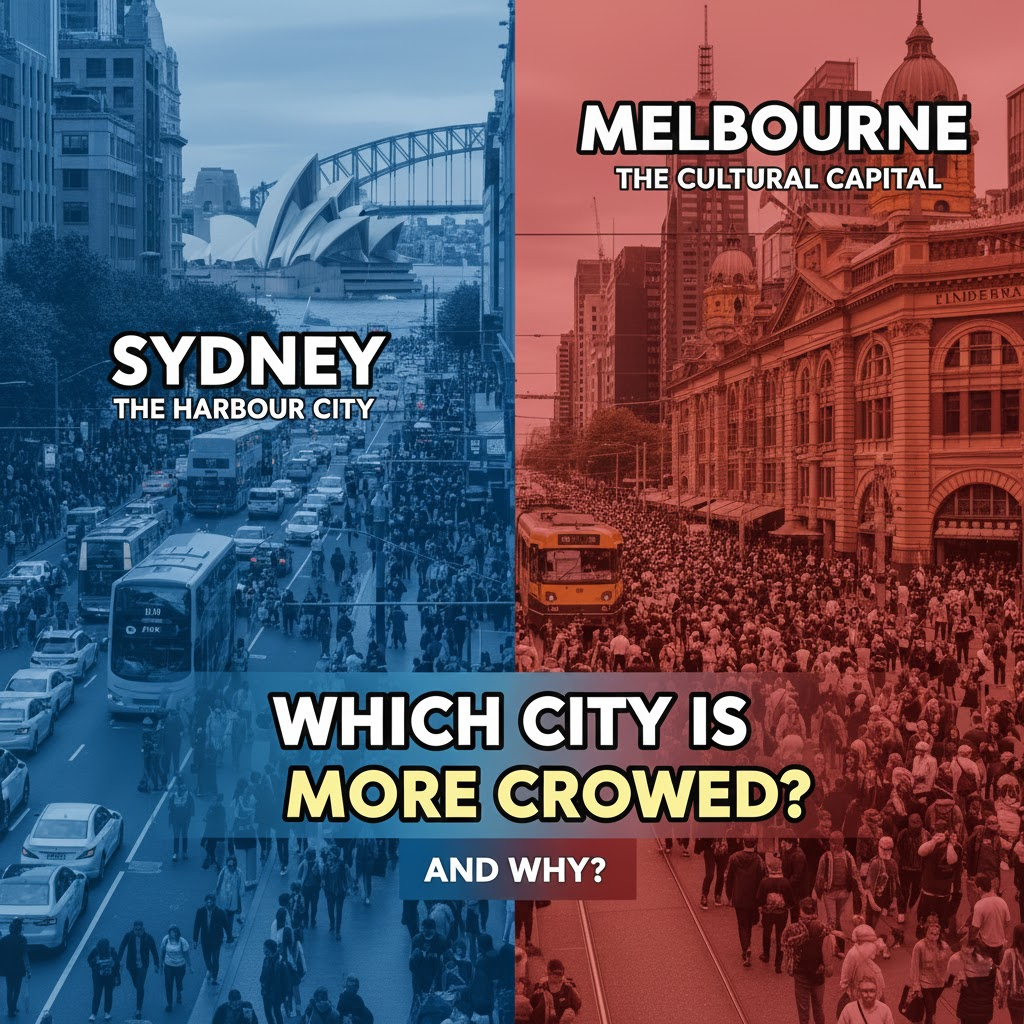
Compare Sydney and Melbourne by population density, public transport crowding, peak hour traffic, and daily life. Latest ABS data shows which city actually feels more crowded and why.
Introduction
Over 5.3 million people now call Greater Sydney home, while Greater Melbourne has surged past 5.2 million. Australia’s two largest cities keep growing fast, driven by immigration and internal migration. Newcomers often ask the same question: which city feels more crowded? The answer depends on more than raw numbers. Population density, urban planning, transport habits, and lifestyle choices all shape the daily experience. This comparison uses the latest ABS population data and real-world indicators to reveal the truth.
Population Density – The Numbers Behind the Feeling
Greater Melbourne covers a larger land area than Greater Sydney, which gives it a clear edge in overall population density. Melbourne records about 550 people per square kilometre, while Sydney sits closer to 450. Yet Sydney’s inner ring (within 10 km of the CBD) reaches over 6,000 people per square kilometre in suburbs like Zetland and Wolli Creek. Melbourne’s densest pockets rarely top 5,000.
The difference comes from geography. Sydney’s harbour and national parks limit outward sprawl, pushing high-rise development into a narrower corridor. Melbourne spreads further west and north with fewer natural barriers. Result: Melbourne wins on paper, but many parts of Sydney feel far more packed.
Daily Congestion – Where the Crowds Actually Hit
Peak hour traffic tells a different story. Sydney’s road network regularly ranks among the most congested in the world. Commuters on the M4, M5, and Sydney Harbour crossings lose over 100 hours a year stuck in traffic. Melbourne drivers face delays too, but the city’s wider arterial roads and completed infrastructure projects (North East Link, West Gate Tunnel) keep average delays lower.
Public transport crowding follows the same pattern. Sydney trains routinely run above 135% capacity during morning peaks. Melbourne’s trams and trains also get busy, especially on the St Kilda Road corridor and Cranbourne/Pakenham lines, but tram crowding in Melbourne rarely matches the crush-load conditions of Sydney’s double-decker trains. Sydney CBD congestion and foot traffic intensity outpace Melbourne’s CBD most weekdays.
Lifestyle and Space – Why Perception Often Beats Statistics
Sydney pushes apartment living harder. Over 35% of inner-city residents now live in high-rise units, compared to about 25% in inner Melbourne. Vertical growth creates dense pockets around transport hubs. Beach crowding at Bondi and Coogee on summer weekends adds to the packed feeling.
Melbourne counters with larger suburban blocks and more green space per capita. Residents enjoy easier access to parks and the bay. Event crowds hit both cities hard — Sydney NYE fireworks and Melbourne’s Australian Open draw millions — but Melbourne spreads visitors across a bigger area.
House prices reflect the pressure. Sydney’s median dwelling value exceeds $1.4 million, partly because land remains scarcer near the centre. Melbourne buyers still pay high prices, but the gap shows how Sydney’s constrained geography drives intensity.
Conclusion
Melbourne edges Sydney in raw population density and suburban breathing room. Yet Sydney feels more crowded for most residents and newcomers because of tighter geography, heavier reliance on a few key corridors, and intense inner-city living. Choose Melbourne if you value space and slightly easier commutes. Pick Sydney if you accept density in exchange for harbour lifestyle and global-city energy. Both cities grow fast — your personal tolerance for crowds will decide the winner.