




Introduction
Immigrating to Australia or moving interstate requires a clear financial plan, but one question dominates all others: is Melbourne cheaper than Sydney 2025? Historically, Sydney, the global financial hub, has maintained a higher cost of living premium. However, in the post-pandemic economy, volatility in the Australian rental market has intensified the debate.1 We dive into the most critical figures for the current year, providing a transparent, category-by-category Sydney vs Melbourne cost of living comparison. Whether you are a skilled migrant, a student, or a family, understanding these financial realities is the first step toward settling comfortably in either NSW or VIC. The decision rests not just on income potential, but on which city truly offers the superior quality of life for your budget.
The Decisive Factor: Sydney vs Melbourne Housing Costs in 2025
The single greatest influence on the cost of living comparison NSW vs VIC is housing. While both capital cities face significant affordability crises, the difference in the average rent Sydney vs Melbourne 2025 is substantial, tipping the balance heavily in favour of Victoria.
The Sydney rental market trends 2025 show that the median advertised rent has climbed to approximately $750 per week for a combined house and unit average. For those seeking houses, median rent in Sydney is projected around $800 per week. T2his extreme pressure is driven by severe housing shortages and high demand in NSW’s most desirable coastal and inner-city locations.
In contrast, Melbourne property market forecast 2025 indicates that rents, while rising, are significantly lower. The equivalent median house rent in Melbourne sits around $580 per week—a staggering difference of $220 per week, or over $11,400 per year in savings for an average household that chooses the Victorian capital.3
For new arrivals and students looking for inner-city living, the disparity in the cost of 1 bedroom apartment Sydney vs Melbourne is even more pronounced.4 A one-bedroom CBD apartment can cost around $3,283 per month in Sydney, versus approximately $2,240 per month in Melbourne. T5his translates to Melbourne rents being 30% to 46% lower than Sydney equivalents, providing a major boost to disposable income.
If your plan involves buying property Sydney vs Melbourne, the story remains the same. Sydney’s median house price is approximately 38% higher than Melbourne’s.6 Melbourne provides greater entry-level opportunities, especially in emerging, family-friendly outer suburbs, making it a clear winner for long-term financial stability and housing affordability NSW vs VIC.7
Beyond the Rent: Groceries, Utilities, and Daily Expenses
While the cost of housing is the heaviest weight on the budget scale, daily expenses form the baseline of affordability. Here, the competition between the two cities is tighter, but Melbourne still retains an edge.
Groceries and Dining
The weekly shop represents a small, yet persistent, premium in New South Wales. Data shows that grocery prices in Sydney are 9.33% higher than in Melbourne.8 Staple items like milk, bread, and fruits consistently cost more in NSW markets.9
- Milk (1L): Costs are typically higher in Sydney.10
- Apples (1kg): Melbourne often tracks lower than Sydney.
Conversely, some high-end dining and restaurant prices in Sydney are surprisingly on par with, or in some niche cases, even slightly lower than, Melbourne. However, for the average migrant or resident concerned with day-to-day savings, the Melbourne grocery environment offers better budget flexibility.11
Utilities and Service Costs
Utility costs are a critical but often overlooked budget item. When comparing essential services for an 85m² apartment, Sydney residents pay an average of $301.80 per month for basic utilities (electricity, water, garbage), while Melbourne residents pay around $237.38 per month. This means Electricity bill comparison Sydney Melbourne analysis shows Sydney utilities are approximately 27% higher.
- Electricity: Melbourne enjoys slightly cheaper average electricity rates per kWh ($0.28/kWh vs Sydney’s $0.31/kWh).12
- Gas prices VIC vs NSW: Gas is more widely used for heating in Victoria’s colder climate, but general pricing remains slightly more competitive than in NSW.
- Internet: The Internet cost Australia is comparable between the two cities, with 100Mbps plans averaging around $79/month in both locations.13
The combination of cheaper groceries and significantly lower utility bills ensures that even when excluding rent, Melbourne is still approximately 12.4% less expensive than Sydney for overall consumer prices.14
Commuting and the Hidden Transport Premiums
The structure and cost of getting around in Sydney and Melbourne differ markedly, especially for daily commuters.15 Both cities offer extensive public transport networks, but the price structures and associated hidden costs tell a distinct story.
Public Transport Fares
When evaluating the Public transport cost Sydney vs Melbourne, fares are regulated by state governments (NSW and VIC). Sydney’s Opal system is widely acknowledged for its technological efficiency and superior reach into regional areas.16 Melbourne relies on the Myki system.17
The key difference lies in the weekly travel caps:
| City | Transport Card | Weekly Cap (Zone 1+2) |
|---|---|---|
| Sydney | Opal | Approx. $50 |
| Melbourne | Myki | Approx. $46 |
Melbourne’s marginally lower cap on weekly travel and its extensive, fare-free tram zone in the CBD give it an edge for inner-city commuters. However, while Melbourne’s Opal vs Myki cost 2025 is slightly lower, Sydney’s Opal system offers better Sunday travel caps and better coverage for long-distance commuters.
The Cost of Driving and Tolls
The real transport premium in Sydney comes from its expansive and costly network of private toll roads.18 For a resident Living in Sydney vs Melbourne who commutes from the Western suburbs, Toll road costs Sydney can easily add up to $22 or more per week.19 Melbourne has far fewer tollways, making driving a substantially cheaper option for the average daily commute in Victoria.
Furthermore, Parking costs Sydney CBD vs Melbourne CBD are notoriously high in Sydney’s highly congested central zones. Melbourne’s design, featuring the CBD grid and the free tram zone, allows many professionals to avoid driving altogether, further reducing their overall transport expenses and carbon footprint. For the cost-conscious motorist, Melbourne is definitively the cheaper option.
What Salary Do You Need for a Comfortable Australian Lifestyle?
The cost of living must always be weighed against earning potential. Sydney, being Australia’s economic engine, often commands a slightly higher nominal salary, especially in the finance and specialised technology sectors. The average gross annual salary tracks higher in New South Wales ($98,500) than in Victoria ($96,000).20
However, the crucial metric for an immigrant planning their budget is the Salary needed to live in Sydney vs Melbourne.
For a single person looking to live comfortably:
- Sydney: A salary between AUD 90,000 and AUD 120,000 is often cited as the necessary range to afford decent accommodation, save, and enjoy a good social life.21
- Melbourne: Due to the substantial savings on rent and utilities, the equivalent comfortable lifestyle can often be achieved with an income closer to the AUD 80,000 to AUD 100,000 mark.
While Sydney offers a slight skilled migrant salary premium in certain industries, the city’s significantly higher rental costs erode this advantage quickly. The lower cost structure in Melbourne means that disposable income after covering essential expenses—especially housing—is often higher for comparable income levels.22 This directly results in superior local purchasing power in Melbourne compared to Sydney.
This data is vital for those asking, “is it worth moving to Melbourne to save money?” For median-income earners, moving to Melbourne provides an immediate and significant improvement in month-to-month cash flow and long-term savings potential.
Lifestyle and Childcare: Where Melbourne Saves You More
A complete Quality of life Sydney vs Melbourne comparison must consider non-essential but vital lifestyle costs, particularly for families.
For those planning to start a family or Sydney vs Melbourne for families 2025, the cost of childcare provides another major financial differentiator.23 Melbourne offers, on average, approximately 14% lower weekly costs for full-time childcare than Sydney. Over the course of a year, this can amount to thousands of dollars in savings, drastically improving the affordability outlook for working parents in Victoria.
Beyond utilities and childcare, general lifestyle expenses are comparable, but Melbourne provides more opportunity for affordable leisure:
- Culture: Melbourne’s strong focus on free public events, festivals, and complimentary museum/gallery entry often provides significant cultural savings compared to Sydney, where many major attractions carry a premium entry fee.24
- Fitness: Gym membership cost Sydney vs Melbourne is roughly equivalent, but the sheer size and variety of Melbourne’s inner suburbs mean more competitive local deals are often available.
- Entertainment: While the Nightlife cost Sydney vs Melbourne is similar for basic drinks, Melbourne’s competitive food scene and vast number of inexpensive, high-quality restaurants often provide better value for money.
Sydney vs Melbourne: The Final Verdict on Affordability
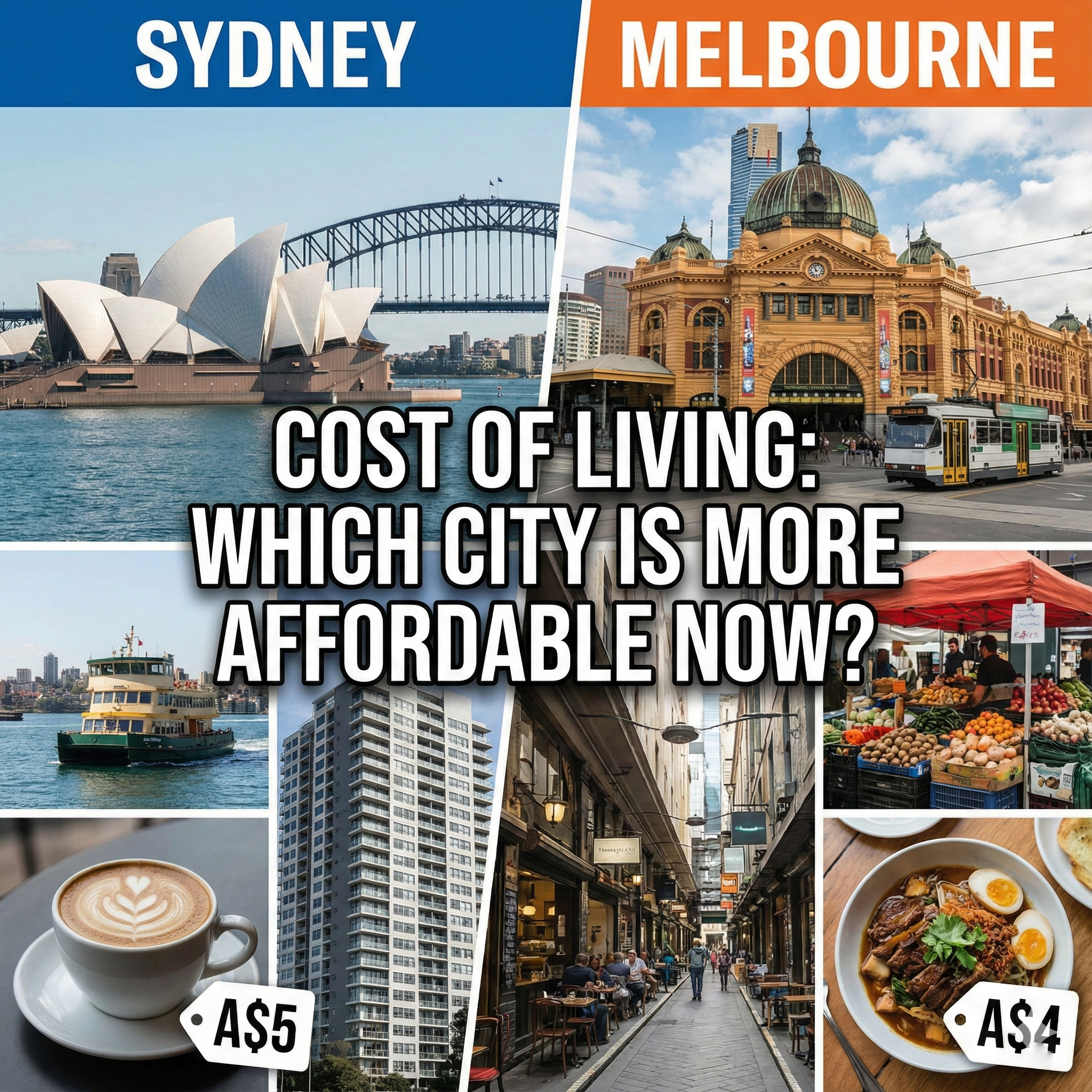
The question of Which City Is More Affordable Now? has a clear answer: Melbourne remains the most affordable major city in Australia 2025 between the two largest capitals.
Melbourne’s combination of:
- Significantly lower housing and rental costs (up to 46% cheaper for apartments).25
- Cheaper utilities and groceries (10-27% lower).
- A highly competitive, slightly cheaper public transport system.
- Lower associated family costs (e.g., childcare).
These factors comfortably offset Sydney’s marginal wage premium. Choosing Living in Sydney vs Melbourne is a trade-off: Sydney offers unparalleled harbour views and a potential high-end salary edge, but Melbourne offers superior disposable income, faster savings potential for property ownership, and a more accessible lifestyle for the average migrant or family.26
Ultimately, your personal choice depends on your priorities—high salary potential in a specific Sydney niche, or greater financial comfort and wealth accumulation in Melbourne. Use a Cost of living calculator Sydney vs Melbourne to tailor the figures to your exact lifestyle, but for broad affordability, Melbourne holds the clear advantage in 2025.