




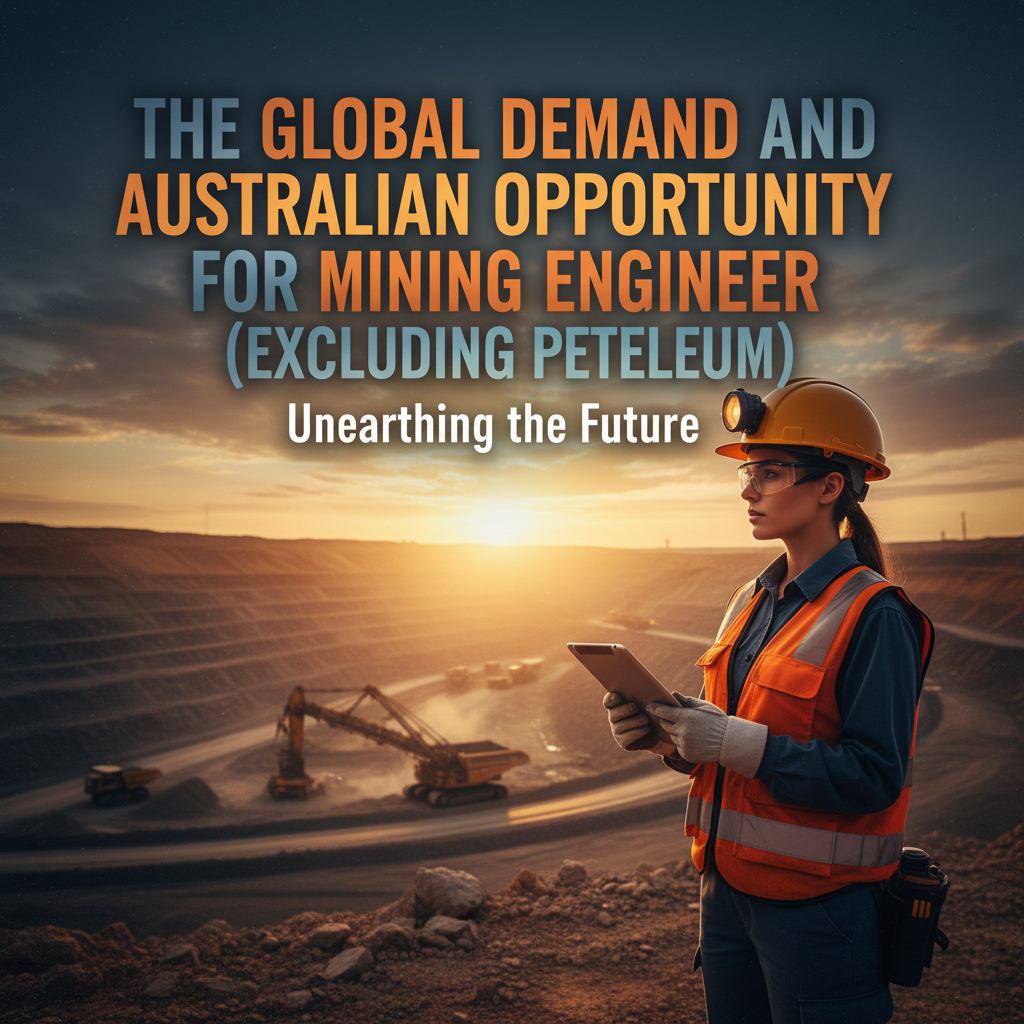
The global resources sector is undergoing its most profound transformation in a century. This demand is fundamentally driven by the shift from fossil fuels to a renewable energy supply chain, creating an unprecedented need for base and Critical Minerals. The world cannot achieve Net Zero targets without a massive increase in the mining of materials essential for electric vehicles (EVs), battery storage, and transmission infrastructure.
The demand for lithium, essential for EV batteries, is projected to grow eight-fold by 2040 in Net Zero Scenarios. Likewise, demand for copper, nickel, cobalt, and rare earth elements is set to double or triple. This surge in Global Mineral Extraction is not a temporary boom; it represents a structural, long-term shift in industrial material requirements.
Mining Engineer professionals are at the forefront of this transition. They are the specialists who determine the feasibility of projects, manage Orebody Management, and execute complex plans for both Hard Rock Mining and bulk extraction. They ensure a steady, reliable, and ethically sourced supply of minerals is available to meet the world’s ambitious climate goals, cementing their role as crucial enablers of the green economy.
Australia’s Unique Opportunity and Skills Shortage
Australia is strategically positioned to capitalise on this global mineral extraction demand. The country holds some of the world’s largest known reserves of iron ore, metallurgical coal, gold, lithium, and nickel, making its Australian Mining Sector the engine room for the global energy transition.
The problem, however, is a persistent and growing Skills Shortage Australia faces in its engineering workforce. A combination of factors—including declining university enrolments in mining-related degrees, an ageing workforce, and the sheer scale of new and existing projects—has created a critical talent gap. This shortage makes the country highly attractive for qualified international Mining Engineer (Excluding Petroleum) professionals seeking Skilled Migration.
Major resource-rich states, particularly Western Australia (WA) Mining (focused on Iron Ore, Gold, and Lithium) and Queensland (QLD) Coal (focused primarily on Metallurgical Coal and Gold), are the primary centres of demand. These regions offer some of the highest salaries and most robust career progression opportunities in the world, with many roles involving FIFO (Fly-In Fly-Out) work models that offer significant lifestyle and financial benefits.
The Project Pipeline: Driving Engineer Demand
The requirement for engineers is reinforced by a robust pipeline of major projects across the country, ensuring Job Growth Mining Engineers will remain strong for the foreseeable future. These projects range from foundational bulk commodities to the most advanced critical minerals.
- Western Australia (WA): The state is dominated by massive-scale iron ore projects by companies like Rio Tinto and Fortescue, and a significant surge in Lithium and Nickel projects. Key developments such as Mineral Resources’ Onslow Iron Project, Rio Tinto’s Brockman Syncline 1 (Iron Ore), and new critical minerals projects like Chalice Mining’s Gonneville Critical Minerals Project highlight the need for expertise in Mine Design and Planning and large-scale operations.
- Queensland (QLD): While metallurgical coal remains a significant export, Queensland is also heavily investing in copper and gold projects. The state’s focus on Underground Mining and advanced mineral processing, such as the Eloise Expansion Project near Mt Isa, demands sophisticated skills in Geotechnical Engineering and ventilation systems.
These projects require engineers to apply the full breadth of their expertise, from initial feasibility studies and environmental impact assessments to daily operational efficiency, safety, and production management.
Career & Economic Incentive: Salary and Stability
The high demand and skill shortage have directly translated into exceptional financial and career prospects for a Mining Engineer (Excluding Petroleum) in Australia.
High Earning Potential
The Mining Engineer Salary Australia is one of the highest among all engineering disciplines globally. Salaries vary significantly based on location (Western Australia generally commands the highest), experience, and the roster type (e.g., FIFO typically offers a substantial premium).
| Career Level | Typical Annual Salary Range (AUD) | Key Locations for Highest Pay |
|---|---|---|
| Graduate | $91,000 – $109,000+ | WA, QLD, NT |
| Intermediate (3-5 yrs) | $130,000 – $160,000 | WA, QLD (Regional) |
| Senior (5-10 yrs) | $160,000 – $210,000+ | Perth, Brisbane, Regional FIFO Sites |
| Principal / Mine Manager | $210,000 – $250,000+ (Total Compensation up to $350,000+) | WA (Pilbara), QLD (Coalfields) |
*Source: Market data from October 2025. These figures are generally base salary and do not include the additional superannuation, bonuses, and share schemes common in the sector.
Stability and Career Pathway Engineering
The current job growth forecast for Mining Engineers is exceptionally strong, projected to increase by over 17% in the five years leading up to 2028. This long-term stability provides a clear Career Pathway Engineering progression, allowing junior engineers to rapidly move into leadership and management roles, such as Mine Manager or Principal Engineer.
The Modern Role: Decarbonisation and ESG
The contemporary Mining Engineer is no longer solely focused on extraction volume; their role is fundamentally integrated with Sustainable Mining practices and ESG (Environmental, Social, and Governance) principles. Australia is rapidly adopting advanced technology to meet its own ambitious net-zero targets, creating new specialisations for engineers.
Focus Areas for the Modern Engineer:
- Automation in Mining: Engineers are leading the adoption of Automation in Mining technologies, including autonomous haulage systems, remotely operated drilling, and digital twins for real-time operation optimisation. This not only increases efficiency but also dramatically improves Mine Safety by removing personnel from high-risk environments.
- Electrification: The shift from diesel to renewable energy power systems is a major challenge. Mining Engineers are designing and integrating large-scale solar, wind, and battery storage solutions directly into mine sites—a necessity for operating remote Regional Australia Mining Jobs.
- Mine Design and Planning: New mine designs incorporate Sustainable Mining principles from day one, focusing on minimal environmental footprint, advanced rehabilitation techniques, and improved mine-to-market efficiencies, demanding expertise in Mineral Processing and waste management.
- Ventilation and Safety: For Underground Mining, engineers are revolutionising ventilation systems, moving away from continuous, energy-intensive ventilation to on-demand systems linked to automated machinery. This change can cut ventilation energy consumption—which can account for 20-25% of a mine’s total use—dramatically reducing the site’s carbon footprint.
The industry views decarbonisation not just as a cost but as a crucial factor for gaining market advantage and ensuring a long-term ‘social licence to operate.’ Engineers who can blend core technical skills (Geotechnical Engineering, Drill and Blast) with digital and clean energy expertise are highly prized.
Australian Immigration Pathways (ANZSCO 233611)
For an international Mining Engineer (Excluding Petroleum), the Australian government offers several clear pathways to permanent residency (PR), cementing the country’s welcoming stance towards this highly sought-after profession. The occupation ANZSCO 233611 is consistently featured on the national skilled occupation lists.
Skilled Migration Visas (Points-Tested)
- Skilled Independent Visa (Subclass 189): A permanent visa that does not require state nomination or employer sponsorship. Selection is based purely on a competitive points test (age, English language, qualifications, experience).
- Skilled Nominated Visa (Subclass 190): A permanent visa requiring nomination from a State or Territory government (e.g., WA, QLD, NSW). State nomination provides an additional five points and is often the most accessible PR pathway for high-demand roles.
- Skilled Work Regional (Provisional) Visa (Subclass 491): A five-year provisional visa requiring state or family sponsorship to live and work in Regional Australia Mining Jobs. This visa provides extra points and offers a clear pathway to a permanent visa (Subclass 191) after three years.
Employer-Sponsored Visas
- Employer Nomination Scheme (Subclass 186): A permanent visa where a qualified Australian employer sponsors the engineer directly. This is a crucial pathway for engineers already working in Australia on temporary visas.
- Temporary Skill Shortage (Subclass 482) / Skills in Demand (Subclass 482 SID): The main temporary work visa for engineers. It requires an Australian employer sponsor and provides a pathway to the Subclass 186 permanent visa.20 The new Skills in Demand visa core skills pathway is specifically designed for high-demand occupations like this.
The crucial first step for all skilled migration applicants is obtaining a positive Skills Assessment from Engineers Australia (EA), which confirms the applicant’s qualifications and work experience are equivalent to Australian standards.
Conclusion: Your Next Step to an Australian Mining Career
The confluence of global green energy mandates and Australia’s vast mineral wealth has created an unparalleled Career Pathway Engineering opportunity. The Mining Engineer (Excluding Petroleum) is now a vital strategic role, essential for sustainable global development, commanding an exceptional High Earning Potential and backed by a stable future demand. The Australian government’s proactive Skilled Migration system provides clear, established routes for international professionals to transition into this booming sector. Do not wait for the opportunity to pass; take the first step towards your positive Skills Assessment and securing your place in Australia’s vital Australian Mining Sector.