



Explore trends and opportunities for agricultural engineers in Australia’s thriving agritech sector, from precision farming to sustainable solutions.
Introduction
Australia’s agricultural sector contributes over $70 billion annually to the economy, yet faces challenges like climate change and labor shortages. Enter the agritech boom, a game-changer revolutionizing farming through technology. For agricultural engineers, this surge presents exciting career prospects. From designing smart farming devices to advancing sustainable practices, opportunities abound. This article explores the trends driving Australia’s agritech revolution and highlights how agricultural engineers can seize emerging roles to shape the future of farming.
The Rise of Australia’s Agritech Boom
Australia’s agritech sector is thriving, fueled by a push for efficiency and sustainability. The agritech boom in Australia integrates cutting-edge technologies to address challenges like water scarcity and soil degradation. Valued at over $4 billion, the industry is projected to grow as global demand for food rises. Agricultural engineers play a pivotal role, designing solutions that optimize resources and boost productivity.
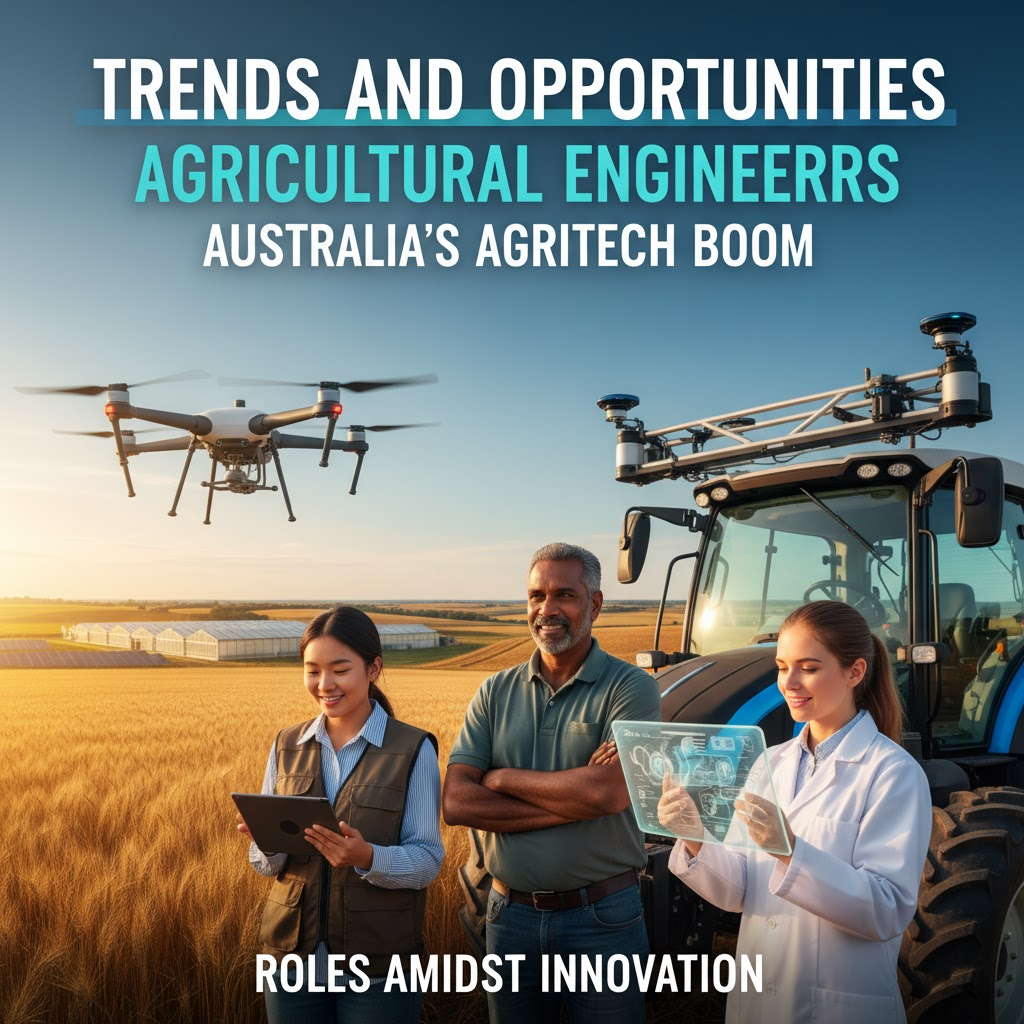
Precision agriculture trends lead this transformation. Technologies like GPS-guided machinery and IoT-enabled sensors allow farmers to monitor crops with unprecedented accuracy. Agricultural engineers are at the forefront, developing precision farming technology that minimizes waste and maximizes yield. For instance, soil health monitoring systems, designed by engineers, provide real-time data on nutrient levels, enabling targeted interventions. This demand for innovation has spurred agricultural engineering jobs in Australia, particularly in rural innovation hubs like Queensland and Victoria.
The government supports this growth through initiatives like the National Farmers’ Federation 2030 Roadmap, which emphasizes digital agriculture in Australia. Engineers with expertise in data analytics for agriculture or irrigation engineering innovations are increasingly sought after, as farms transition to tech-driven models.
Key Trends Shaping Agricultural Engineering Roles
Several trends are reshaping opportunities for agricultural engineers. First, farm robotics in Australia is gaining traction. Automated harvesters and robotic weeders reduce reliance on manual labor, addressing workforce shortages. Engineers design these smart farming devices, integrating AI to enhance functionality. For example, robotic systems for fruit picking, developed in collaboration with universities like Sydney’s, are transforming orchards.
Drone applications in agriculture are another game-changer. Drones equipped with multispectral cameras monitor crop health and map fields, providing data for precision interventions. Agricultural engineers specializing in drone technology are in demand, with roles focusing on system integration and data interpretation. Companies like AgEagle are expanding operations in Australia, creating openings for agri-data analyst roles.
Water management in agritech is critical in Australia’s arid climate. Engineers are innovating with smart irrigation systems that use sensors to optimize water use. Irrigation engineering innovations, such as drip systems controlled by AI, are reducing water waste by up to 30%. These advancements align with sustainable farming opportunities, as farmers aim to meet environmental regulations and consumer demand for eco-friendly practices.
AI in agritech is also revolutionizing livestock management. Livestock monitoring tech, such as wearable sensors for cattle, tracks health and movement, improving welfare and productivity. Engineers develop these systems, blending expertise in IoT and animal science. Similarly, blockchain in agriculture supply chains ensures transparency, with engineers designing platforms to trace produce from farm to table.
Opportunities for Agricultural Engineers in Australia
The agritech boom is creating diverse career paths for agricultural engineers. Companies like John Deere and CSIRO are hiring for roles like agritech solution designers, who develop customized systems for farms. These positions require skills in AI, robotics, and data analytics, offering salaries ranging from AUD 80,000 to 120,000 annually, depending on experience.
Sustainable farming opportunities are particularly prominent. Engineers specializing in carbon sequestration farming design systems to capture carbon in soil, supporting Australia’s net-zero goals. Projects like the Carbon Farming Initiative rely on engineers to implement technologies that enhance soil health and reduce emissions.
Rural innovation opportunities are also expanding. Regional hubs like Toowoomba and Wagga Wagga are becoming agritech centers, hosting startups and research facilities. Engineers can work on projects ranging from vertical farming to renewable energy integration in agriculture. For immigrants, Australia’s Skilled Occupation List includes agricultural engineering, making it easier to secure visas like the Subclass 482 or 186 for qualified professionals.
Collaboration is key in this field. Engineers often work with data scientists, agronomists, and farmers to develop holistic solutions. For instance, designing smart farming devices requires understanding both technical specifications and practical farm needs. Universities and research bodies offer training programs, such as those at the University of Melbourne, to bridge skill gaps for newcomers.
Challenges and How to Prepare for Agritech Roles
While opportunities are plentiful, challenges exist. The rapid pace of technological change requires engineers to stay updated on tools like AI and blockchain. Additionally, working in rural areas may involve adapting to remote environments, which can be a shift for urban professionals.
To prepare, aspiring engineers should pursue relevant qualifications. A degree in agricultural engineering or related fields like mechatronics is essential. Certifications in AI, IoT, or data analytics for agriculture can boost employability. Online platforms like Coursera offer courses on precision farming technology, while local institutions provide hands-on training in drone applications or irrigation systems.
Networking is crucial. Joining industry groups like the Australian Agritech Association connects professionals with employers. Immigrants should explore visa pathways early, consulting with migration agents to navigate requirements for agricultural engineering jobs in Australia. Practical experience, such as internships with agritech startups, can also set candidates apart.
Conclusion
Australia’s agritech boom offers agricultural engineers a wealth of opportunities to innovate and grow. From precision agriculture to sustainable farming, roles are evolving to meet the demands of a tech-driven future. By leveraging skills in AI, robotics, and data analytics, engineers can thrive in this dynamic sector. Explore visa options and upskill in emerging technologies to join Australia’s agricultural revolution today.